Your Chest Tightens by Three in the Afternoon — Three Points You Can Use Without Leaving Your Desk
A five-minute sequence that classical practice built around one pairing, not three separate points.
Reviewed by Jimmy Yu, Certified Acupuncturist · Updated 2026-07-13
Quick answer
Three points cover most afternoon desk tension: Neiguan PC-6 ("Inner Pass") on the inner forearm, Gongsun SP-4 ("Grandfather Grandson") on the inner arch of the foot, and Danzhong CV-17 ("Chest Centre") on the breastbone. Classical practice pairs the first two specifically for the chest and upper abdomen.
The Three O’Clock Tightening
There is a shape to the office day that people describe almost identically. Fine in the morning, and then somewhere between two and four the chest gets tight, the shoulders creep up, and the breath gets shallow without anyone deciding it should.
By six it has usually become something else — a neck ache, a headache behind the eyes, or the particular flat irritability that people apologise for on the drive home.
What strikes me is that most people notice it for the first time when I ask. They have been holding their breath through the afternoon for years and had filed it under "work."
The useful thing about this window is that it is predictable. Something you can see coming at the same time each day can be met at the same time each day, and five minutes at half past two is worth far more than an hour of stretching at nine at night.
How Chinese Medicine Reads It
Chinese medicine has a specific vocabulary for this. The chest is where qi gathers, and the Nanjing chapter forty-five (《难经·四十五难》) names the point in the centre of the breastbone as the meeting point of qi — the place the tradition regards as the gathering site for the whole system.
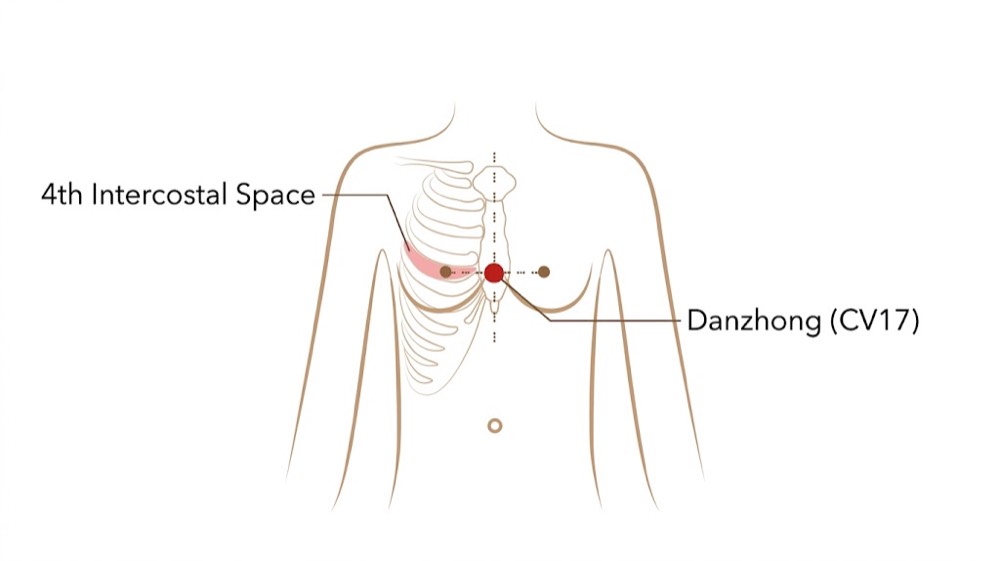
That point is Danzhong CV-17 ("Chest Centre"). It sits on the midline, in the centre of the breastbone, on the bone itself — level roughly with the fourth rib space. It is a point on the sternum, not on breast tissue, and it is worth being precise about that.
The second piece is a pairing rather than a single point. The classical verse of the eight confluent points, recorded in the Ming compilation Zhenjiu Dacheng (《针灸大成》), pairs Gongsun SP-4 with Neiguan PC-6 and assigns them to the stomach, heart and chest — 公孙内关胃心胸. Nine centuries of practitioners have used that line as a working shorthand.
Neiguan PC-6 ("Inner Pass") sits three finger-widths above the wrist crease, on the inner forearm, between the two tendons you can feel when you make a light fist. Gongsun SP-4 ("Grandfather Grandson") sits on the inner edge of the foot, in the hollow you find by sliding back along the arch from the base of the big toe until your thumb drops into a dip.
Why a foot point for a chest complaint? Because in this system the two connect through the deeper vessels, and because working only at the site of the tightness tends to chase the symptom around. The pairing is what gives the sequence its reach.
The pattern underneath all of this is constraint rather than shortage. The Suwen chapter "Ju Tong Lun" (《素问·举痛论》) puts it in three characters — 思则气结, overthinking knots the qi. Knotted, not empty, which is why five minutes of release does more here than an hour of rest.
What’s Real, What’s Myth
Myth: you need to do the whole routine or it is not worth starting. Of the three, Neiguan PC-6 alone at the moment your chest tightens does most of the work. I would rather someone did one point reliably at half past two than three points occasionally at nine at night.
Myth: press harder for a stronger effect. On the breastbone in particular, firm pressing is uncomfortable and unnecessary — light fingertip tapping suits that point far better. On the forearm, steady moderate pressure with slow breathing out beats hard thumbing every time.
Myth: the point on the chest is somewhere near the breast. It is not. It is on the midline of the breastbone, on the bone. Anatomical precision matters here, both for the technique and for anyone following along at their desk.
Myth: this replaces getting up. It does not, and I would not want it to. Afternoon tightness is partly a posture and stillness problem, and two minutes of walking to the far end of the building is a genuine part of the answer rather than a poor substitute for one.
Real: the breath is doing most of the work. Every one of these points is more effective with a long slow exhale, and that is not a coincidence — releasing the chest is what all three are aimed at.
Four Things You Can Do This Week
1. Set an alarm for half past two. This is the least appealing item on the list and the one that makes the difference. Meeting the pattern before it arrives works; catching it at six does not.
2. Hold Neiguan PC-6 ("Inner Pass") for a minute on each side. Three finger-widths up from the wrist crease, between the two tendons, thumb pressure that is firm but comfortable. Breathe out slowly through the whole minute — longer out than in. This is the one to use in a meeting, since nobody can see you doing it.
3. Tap Danzhong CV-17 ("Chest Centre") for a minute. Fingertips, light and rhythmic, on the midline of the breastbone, on the bone. Most people find themselves sighing partway through, which is the point rather than an interruption.
4. Work Gongsun SP-4 ("Grandfather Grandson") once you are home. Slide your thumb back along the inner arch from the base of the big toe until it drops into a hollow, then hold steady pressure for a minute each side. Shoes make this one awkward at the desk, so it belongs to the evening.
When to See a Doctor
Chest tightness is the one symptom where I would always rather you checked. Chest pain or pressure that spreads to the jaw, neck, back or either arm, or arrives with breathlessness, sweating or nausea, needs emergency care straight away. Do not press a point and wait to see.
See your GP soon if the tightness is new, if it comes on with exertion and eases with rest, if it wakes you at night, or if it has been steadily worsening over weeks. That combination needs assessment before it needs a routine.
Book an appointment for breathlessness that is new or getting worse, for palpitations that come with dizziness or fainting, or for a cough that has lasted more than three weeks. None of these are pattern questions.
And on the mental health side: if the afternoon tightness is part of anxiety that is affecting your sleep, work or relationships, or if you are having panic attacks, please speak to your GP or a psychologist. What is described here sits alongside that care, not instead of it.
Which Constitution This Usually Points To
Tightness that builds under pressure, eases on holiday, and comes with sighing and moving symptoms points to a qi stagnation constitution (气郁质). If that sounds like your working week, the points above are aimed squarely at your pattern.
Two variations are worth naming. If the tightness comes with heaviness, a thick tongue coating and a foggy head, there is damp in the picture too. If it comes with palpitations, breathlessness on stairs and heavy fatigue, there is likely a qi-deficient (气虚质) base underneath, and gentler is better.
If you want to know which of those you are working with, the quick assessment on this site walks you through 29 gentle questions in about three minutes and gives you a daily plan matched to your type.
Watch: Jimmy explains this in the clinic
Keep Reading
Anxious or Qi Stagnant?
Tight chest, constant sighing, symptoms that move around — the pattern behind stress held in the body.
Read →The Foot Point Pressed Wrong
Why grinding into the point between your first two toes can leave you more wound up than before.
Read →Stress Sits Under Your Ribs
Tight ribs, bloating that tracks with your workload, and a short fuse by six — one pattern, not three.
Read →Awake at Two Again
A racing mind and a tight jaw at two in the morning — the hour the body clock assigns to the Liver.
Read →The Jaw You Clench
Tight jaw, morning ache and grinding — and why the base of the skull matters more than the jaw.
Read →Cold Hands, Warm Body
When the warmth is stuck rather than missing — and the one clue that tells you which you have.
Read →Find Your Constitution
29 gentle questions, about three minutes, and you have your TCM body type — so this guidance actually fits you.
Take the quick quiz →Related
Learn about the Qi Stagnation constitution →Frequently Asked Questions
Can I do these points in a meeting?
Neiguan PC-6 on the inner forearm, yes — it is hidden under a sleeve and needs nothing but a thumb and a slow breath out. The breastbone point is visible, so it suits the two minutes between meetings, and the foot point realistically belongs to the evening once your shoes are off.
How long before I notice anything?
Most people feel the chest loosen within the first minute or two of the first session, mainly through the exhale. Whether the whole afternoon pattern changes takes longer — give it two weeks of doing it at the same time each day before judging.
Where exactly is the chest point?
On the midline of the breastbone, on the bone itself, level roughly with the fourth rib space — about a third of the way down from the top of the sternum. It is not on breast tissue. If your fingertips are on anything soft, move back to the midline and onto the bone.
Is there anyone who should skip these?
Avoid Gongsun SP-4 and firm foot work during pregnancy without checking with your own practitioner first, and avoid pressure over any area of skin that is broken, inflamed or recently injured. If you have a pacemaker or any implanted device in the chest wall, skip the tapping on the breastbone and ask your doctor.
Last updated: 2026-07-13
This page offers general TCM educational perspectives, not medical advice or a diagnosis. For any health concern, please consult a licensed healthcare professional.