Men Don’t Store Stress in the Shoulders — They Store It Under the Ribs
Tight ribs, a bloated belly and a short fuse are one pattern, not three separate problems.
Reviewed by Jimmy Yu, Certified Acupuncturist · Updated 2026-07-13
Quick answer
A band of tightness under the ribs, bloating that worsens with stress, belching, and irritability by early evening form a single pattern in Chinese medicine: constrained liver qi pressing on the stomach. It is common in desk-bound men, it explains why digestion tracks with workload, and it responds faster than most patterns.
The Band Under the Ribs
Ask a man where he holds stress and he will say his shoulders. Press along the bottom edge of his ribs and something else entirely comes up — a band of tightness he did not know was there, often noticeably worse on the right.
The rest of the picture goes with it. Bloating that starts in the afternoon and is worse on the days that went badly. Belching after meals. A short fuse from about six in the evening, which everyone at home has noticed and nobody mentions.
There is usually a distinctive detail about appetite: little interest in food at lunchtime, then a large fast dinner eaten in front of a screen, then a heavy, distended evening.
What makes this recognisable rather than vague is how tightly it tracks with the working week. Fine on holiday, back within two days of returning. That correlation is the pattern showing itself.
How Chinese Medicine Reads It
The Lingshu chapter "Jing Mai" (《灵枢·经脉》) traces the liver channel through the lower abdomen and describes it spreading through the flanks and ribs — 布胁肋. That is a precise anatomical claim about where this pattern is felt, written a very long time ago.
The Suwen chapter "Ling Lan Mi Dian Lun" (《素问·灵兰秘典论》) then describes the Liver as 将军之官 — the office of the general, from which planning and deliberation emerge. The part of you that pushes forward, holds a strategy, and gets frustrated when blocked.
The Liver in this system governs the free movement of qi. Its characteristic failure is constraint rather than weakness, and constrained qi does not sit quietly — it presses sideways into whatever is next to it.
What is next to it is the digestive system, and Zhang Zhongjing named the consequence in the Jingui Yaolue (《金匮要略》) in a line every student learns
见肝之病,知肝传脾,当先实脾
when the liver is disordered, expect it to pass to the spleen, so support the spleen first.
《金匮要略》
That is the whole mechanism in one sentence, and it explains the thing men find most confusing about this: their digestion is worst on their worst weeks, and no dietary change fixes it, because the problem is arriving from next door.
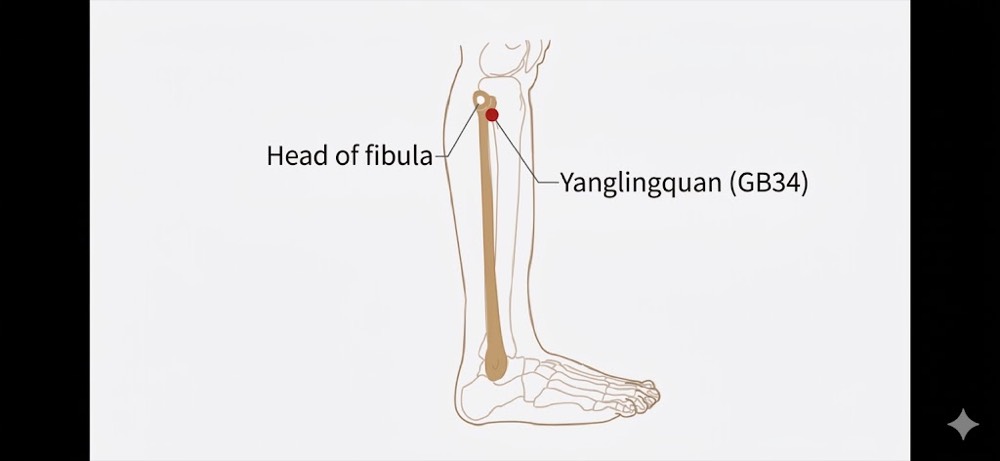
The points follow the anatomy. Qimen LR-14 ("Cycle Gate") sits on the front of the ribcage, directly below the nipple line, in the sixth rib space. Zhangmen LR-13 ("Camphorwood Gate") sits at the free end of the eleventh rib, on the side of the trunk. Yanglingquan GB-34 ("Yang Mound Spring") sits in the dip below and in front of the bony bump on the outer lower leg. Zusanli ST-36 ("Leg Three Li") supports the digestive side that is taking the pressure.
What’s Real, What’s Myth
Myth: bloating that tracks with stress means a food intolerance. Food intolerance is fairly consistent — the same food produces roughly the same result whatever week it is. If the same lunch is fine in January and a problem in March, the variable is not the lunch, and eliminating foods one by one is a long road to nowhere.
Myth: the shoulders are where men hold tension. The shoulders are where men notice tension, because that is where it becomes painful. The ribs are usually tighter and rarely examined, which is why nobody has told you about it.
Myth: this is a matter of relaxing more. Rest alone does surprisingly little for constraint. What moves it is movement — the classical instruction for constrained wood is to let it through, and in practice that means walking briskly rather than sitting quietly.
Myth: irritability at six in the evening is a character problem. It is one of the most reliable clinical markers of this pattern, and it usually improves within a fortnight of proper daily movement. Men are often visibly relieved to hear it described as a pattern rather than a failing.
Real: eating in a rush makes it much worse. A large fast dinner in a tight, constrained body is the specific combination that produces the heavy distended evening, and slowing the meal down is one of the more effective changes available.
Six Things You Can Do This Week
1. Walk briskly for twenty to thirty minutes, four times a week, at a pace where your breathing changes. This does more than everything else on the list combined. Strolling is pleasant and does not shift constraint — the intensity is the active ingredient.
2. Work along the rib edge. Sitting, hook your fingertips under the bottom edge of your ribs and stroke outward from the centre toward the sides, following the rib line, thirty slow strokes each side. Moderate pressure, breathing out as you stroke. Most men find the right side noticeably tighter.
3. Hold Qimen LR-14 ("Cycle Gate") and Zhangmen LR-13 ("Camphorwood Gate") for a minute each. The first sits in the sixth rib space below the nipple line, the second at the free end of the eleventh rib on your side. Steady, comfortable pressure — these are rib spaces, so no digging.
4. Press Yanglingquan GB-34 ("Yang Mound Spring") for a minute each side. Find the bony bump on the outside of your lower leg below the knee and drop into the dip just below and in front of it. This is the classical point for tightness of the sinews and it often feels sore in this pattern.
5. Slow the evening meal down and make it smaller. Twenty minutes at a table without a screen, finishing comfortable rather than full. The classical logic is to support the digestive side that is under pressure, and this is the most direct way to do it.
6. Put the walk between work and home. Ten to fifteen minutes on the way in the door does more for the six o’clock fuse than anything you can do once you are already through it. Several men have told me this was the change their family noticed first.
When to See a Doctor
Pain under the right ribs deserves a proper look rather than a stretch. See your GP promptly for pain there that is severe, that comes in episodes lasting hours, that travels to the right shoulder blade, or that comes with fever, yellowing of the eyes or skin, or pale stools.
Chest tightness needs to be separated out clearly. Chest pain or pressure that spreads to the jaw, neck, back or arm, or comes with breathlessness, sweating or nausea, requires emergency care immediately, not a point routine. Tightness that comes on with exertion and eases with rest needs assessment soon.
Book an appointment for bloating that is persistent rather than fluctuating, for a change in bowel habit lasting more than three weeks, for unintended weight loss, for difficulty swallowing, or for vomiting that keeps recurring. Persistent reflux worth medicating most weeks is also worth reviewing.
And the part men skip: if irritability has become anger you are not comfortable with, if your mood has been low most days for a fortnight, or if you are drinking more to unwind, please talk to your GP. This article describes a body pattern, and it sits alongside that conversation rather than replacing it.
Which Constitution This Usually Points To
Tightness under the ribs, bloating that tracks with workload, belching, and a temper that arrives at six point clearly toward a qi stagnation constitution (气郁质). The order that matters here is classical: get the qi moving first, and much of the digestive side settles behind it.
Two overlays are common in desk-bound men. Add heaviness, a thick greasy tongue coating and a foggy head and there is damp in the picture. Add red eyes, a bitter taste in the morning and disturbed sleep and there is heat, which usually means the alcohol and the late dinners are doing more than their share.
If you want to know which layer to work on first, the quick assessment on this site walks you through 29 gentle questions in about three minutes and gives you a daily plan matched to your type.
Watch: Jimmy explains this in the clinic
Keep Reading
Anxious or Qi Stagnant?
Tight chest, constant sighing, symptoms that move around — the pattern behind stress held in the body.
Read →The Foot Point Pressed Wrong
Why grinding into the point between your first two toes can leave you more wound up than before.
Read →Three Points for Desk Tension
A five-minute sequence for the chest tightness that arrives every afternoon around three.
Read →Awake at Two Again
A racing mind and a tight jaw at two in the morning — the hour the body clock assigns to the Liver.
Read →The Jaw You Clench
Tight jaw, morning ache and grinding — and why the base of the skull matters more than the jaw.
Read →Cold Hands, Warm Body
When the warmth is stuck rather than missing — and the one clue that tells you which you have.
Read →Find Your Constitution
29 gentle questions, about three minutes, and you have your TCM body type — so this guidance actually fits you.
Take the quick quiz →Related
Learn about the Qi Stagnation constitution →Frequently Asked Questions
Why is my right side tighter than my left?
It is the more common finding in this pattern, and the liver channel’s course through the flanks is the traditional explanation. It is worth noting the difference rather than worrying about it — but new, persistent or painful right-sided rib pain, as opposed to tightness, should be checked by your GP.
Can this really be why I bloat?
When the bloating tracks with your workload rather than with specific foods, this is the reading that fits best. The classical line is that a constrained liver passes the problem to the digestive system, which is why the same meal behaves differently in a bad week than in a good one.
How long before I notice a difference?
Faster than most patterns. Many men notice looser ribs and a calmer evening within a week of proper brisk walking, and clearer digestion by three weeks. If six weeks of consistent effort changes nothing, it is worth reassessing rather than doing more of the same.
Is alcohol making this worse?
Usually, yes — in this framework it adds heat and damp to a pattern that is already constrained, and it tends to show up as red eyes, a bitter taste in the morning and worse sleep. Most men who cut back for a fortnight report the rib tightness and the evening irritability both improve.
Last updated: 2026-07-13
This page offers general TCM educational perspectives, not medical advice or a diagnosis. For any health concern, please consult a licensed healthcare professional.