The Shoulder Knot That Comes Back Three Days After Every Massage — Why More Pressure Isn’t the Answer
Tightness that moves is one pattern. Tightness that returns to the same square inch is another.
Reviewed by Jimmy Yu, Certified Acupuncturist · Updated 2026-07-13
Quick answer
A knot that recurs in exactly the same spot after every massage is read in Chinese medicine as a fixed obstruction rather than a tight muscle. Fixed, recurring, well-localised tightness points to blood stasis, which responds to sustained movement and gentle regular work rather than to deep pressure.
Same Spot, Every Time
You could put a finger on it in the dark. It is on the top of the shoulder, usually the right, about halfway between the neck and the point of the shoulder, and it has been there for years.
A deep tissue massage helps for three days. Sometimes two. Then it is back in exactly the same square inch, and the therapist works harder next time, and the cycle continues.
The quality is worth noticing. It is not a diffuse ache that wanders around the shoulder blade — it is a fixed, hard, well-defined spot that hurts when pressed and stays where it is.
And a detail people mention when asked: bruises that take longer than they should to fade, and a dull ache in that spot in cold weather.
How Chinese Medicine Reads It
The Suwen chapter "Ju Tong Lun" (《黄帝内经·素问·举痛论》) gives the principle every practitioner learns first: 不通则痛 — where there is no free passage, there is pain. Pain is a traffic report in this system, not a damage report.
What the tradition then does is sort the traffic problem by its behaviour. Pain that moves around, changes with mood and comes and goes is described as stuck qi. Pain that is fixed, sharp or boring, stays in one place and is worse with pressure is described as stasis — something more substantial than qi has stopped moving.
That distinction is the whole reason this article exists. A wandering shoulder ache and a fixed knot in the same square inch for three years are different patterns, and deep pressure suits neither of them particularly well.
The same chapter adds how it gets there: 寒则气收 — cold contracts. Long hours in one position, a cold draught on the shoulder, and a system that is not moving much: that combination is described as producing exactly this kind of fixed, localised obstruction.
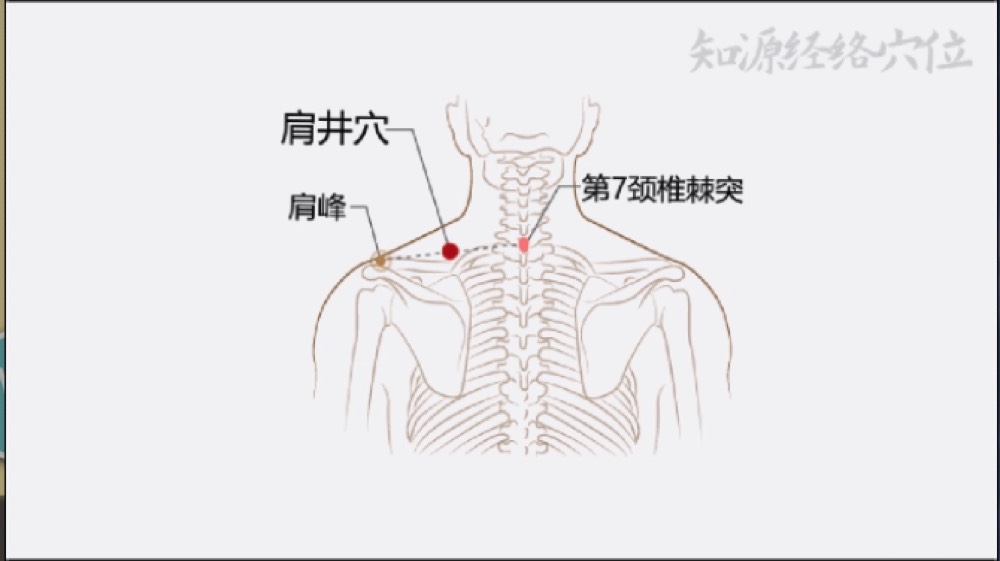
Jianjing GB-21 ("Shoulder Well") sits at the highest point of the shoulder, midway between the base of the neck and the point of the shoulder — which is usually precisely where people put their finger. Important: this point is contraindicated in pregnancy, and strong pressure there must be avoided throughout.
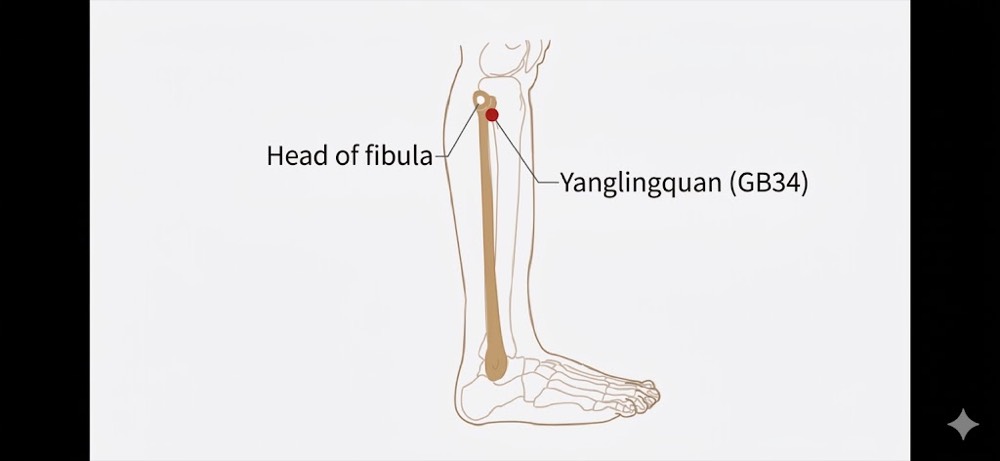
Tianzong SI-11 ("Heavenly Gathering") sits in the middle of the shoulder blade, in the shallow dip you find about a third of the way down. Yanglingquan GB-34 ("Yang Mound Spring") sits below the outside of the knee and is the classical gathering point of the sinews — the distal point for tightness anywhere in the body.
What’s Real, What’s Myth
Myth: a knot needs enough pressure to break it up. There is no classical or physiological basis for breaking anything up, and in practice very heavy pressure often leaves the area more guarded — sore for two days, then tighter than before. Moderate sustained pressure with slow breathing does more.
Myth: if it comes back, the massage was not deep enough. If three years of increasing pressure has not held, more pressure is unlikely to be the missing variable. What usually is missing is daily movement and the position you sit in for eight hours.
Myth: stretching alone will resolve a fixed knot. For a stasis picture, stretching is the second half of the job at best. Movement that raises the heart rate — brisk walking, swimming, cycling — is what gets things moving; stretching afterwards keeps the area supple. Doing only the stretching is why people plateau.
Myth: shoulder points are safe for everyone. Jianjing GB-21 is contraindicated in pregnancy, and it is one of the more firmly held cautions in the tradition. If you are pregnant or might be, do not have this point pressed, and tell any massage therapist working on your shoulders.
Real: cold on the shoulder matters more than people expect. An air-conditioning outlet above your desk, or a draught on one shoulder while you drive, is a genuine and very fixable contributor to a one-sided knot.
Six Things You Can Do This Week
1. Move the qi before you work the spot. Brisk walking for twenty to thirty minutes, four times a week, at a pace where your breathing changes. In classical order, qi moves first and blood follows — and this is the part almost everyone skips in favour of more massage.
2. Add stretching after the walking, not instead of it. Five minutes of neck, chest and shoulder-blade work once you are warm. Both halves, in that order, or you will keep plateauing.
3. Press Jianjing GB-21 ("Shoulder Well") gently, for a minute each side. Opposite hand over the top of the shoulder, moderate sustained pressure with slow breathing out — not digging. Not in pregnancy, and skip it entirely if there is any chance you are pregnant.
4. Work Tianzong SI-11 ("Heavenly Gathering") against a wall. Put a tennis ball between your shoulder blade and the wall, find the tender dip in the middle of the blade, and lean into it with steady moderate pressure for a minute each side.
5. Press Yanglingquan GB-34 ("Yang Mound Spring") for a minute each side. Find the bony bump below the outside of the knee and drop into the dip just below and in front of it. Working a distal point for a local knot is standard classical practice, and it often eases the shoulder while you are doing it.
6. Find the draught. Look for an air-conditioning outlet above your desk, a car vent aimed at one shoulder, or a window you sit beside. Cover the shoulder, move the chair, redirect the vent. For a stubbornly one-sided knot this is often the whole story.
When to See a Doctor
Shoulder and neck symptoms have red flags worth knowing. See your GP promptly for weakness, numbness or tingling down an arm, for pain that wakes you every night, for a shoulder you cannot lift, or for pain after a fall or injury.
Seek emergency care for shoulder, arm or jaw pain that comes on with exertion, or with chest discomfort, breathlessness, sweating or nausea. Left shoulder pain in particular can be a cardiac presentation, and it should never be massaged and waited out.
Book an appointment for a lump in the neck or above the collarbone, for unintended weight loss, for night sweats, for a persistent cough with shoulder pain, or for pain that is steadily worsening over weeks regardless of what you do. New severe neck pain with fever and a stiff neck needs same-day assessment.
And two cautions on the steps above: avoid firm pressure at Jianjing GB-21 throughout pregnancy, and avoid strong pressure anywhere if you have osteoporosis, a bleeding disorder or take blood-thinning medication. Check with your doctor first in those situations.
Which Constitution This Usually Points To
A fixed, well-localised knot that returns to the same spot, worse in cold weather and with pressure, alongside bruises that take a while to fade and a dull ache that has been there for years, points toward a blood stasis constitution (血瘀质). The classical order matters: move the qi first with sustained aerobic movement, then the blood, and expect this to take a season rather than a fortnight.
If the tightness wanders around the shoulder and neck, changes with your mood and eases on holiday, that is qi stagnation (气郁质) rather than stasis — and brisk walking alone often resolves it.
If the shoulder is heavy and aching rather than knotted, worse in humid weather, a damp picture (痰湿质) leads, and food matters as much as movement.
The quick assessment on this site walks you through 29 gentle questions in about three minutes and gives you a daily plan matched to your type, including whether your shoulder is a stuck problem or a stagnant one.
Keep Reading
What Do My Nails Say?
Reading ridges, spots, half-moons and nail colour the TCM way.
Read →Dark Circles vs Puffiness
Two different things happening in the same square inch — and why one eye cream cannot address both.
Read →Reading Your Own Cycle
Colour, clots and the timing of the pain — three signals worth noticing each month.
Read →The Foot Point Pressed Wrong
Why grinding into the point between your first two toes can leave you more wound up than before.
Read →Three Points for Desk Tension
A five-minute sequence for the chest tightness that arrives every afternoon around three.
Read →When the Famous Point Backfires
Light-headed and flat after pressing the point below your knee? The technique, not the point, is usually the problem.
Read →Find Your Constitution
29 gentle questions, about three minutes, and you have your TCM body type — so this guidance actually fits you.
Take the quick quiz →Related
Learn about the Blood Stasis constitution →Frequently Asked Questions
Should I stop having massages?
Not at all — moderate work suits this pattern well and many people find it valuable. What is worth changing is the expectation that pressure alone will hold, and the assumption that deeper is better. Massage plus daily movement holds far longer than massage alone.
Why is it always the same side?
Usually posture and draught rather than anything mysterious. A mouse hand, a bag on one shoulder, a phone held against one ear, a vent aimed at one side in the car. Look for the asymmetry in your day before looking anywhere else.
How long will it take to change?
A stasis pattern moves in seasons, not weeks. Most people notice the knot is less tender within three to four weeks of consistent brisk walking, and that it stops returning so quickly after two to three months. If nothing changes at all in eight weeks, have it looked at properly.
Is the shoulder point really unsafe in pregnancy?
Jianjing GB-21 is contraindicated in pregnancy in classical practice, and it is worth respecting. Tell any massage therapist you see, since the top of the shoulder is a routine part of most massage sessions. The shoulder blade point and gentle stretching are fine alternatives.
Last updated: 2026-07-13
This page offers general TCM educational perspectives, not medical advice or a diagnosis. For any health concern, please consult a licensed healthcare professional.