The Most Famous Point in Chinese Medicine Isn’t Right for Everyone — What to Do When It Leaves You Drained
Strong stimulation is a technique, not a virtue, and the people it suits least are often the ones told to use it most.
Reviewed by Jimmy Yu, Certified Acupuncturist · Updated 2026-07-13
Quick answer
Zusanli ST-36 ("Leg Three Li") is the most recommended point in Chinese medicine, but heavy pressure leaves some people light-headed, yawning and flat for hours afterwards. In classical practice that response means the technique was too strong for the pattern. Gentler, shorter work — or the inner arch point instead — usually suits better.
The Yawning That Starts Halfway Through
Someone presses the famous point below the knee for the first time, exactly as instructed — hard, three minutes each side — and halfway through they start yawning. Then their ears feel far away, they need to sit down, and the rest of the afternoon is a write-off.
They almost always assume this means it is working. Something is clearly happening, and everything they have read says stronger is better.
In my clinic this is one of the more common things I have to unpick. Feeling light-headed, sweaty or profoundly flat during point work is not a sign of progress — it is the body saying the dose was too strong for what it had available.
The point is not the problem. It remains the most useful single point in the tradition. What is wrong is the assumption that one technique fits every body.
How Chinese Medicine Reads It
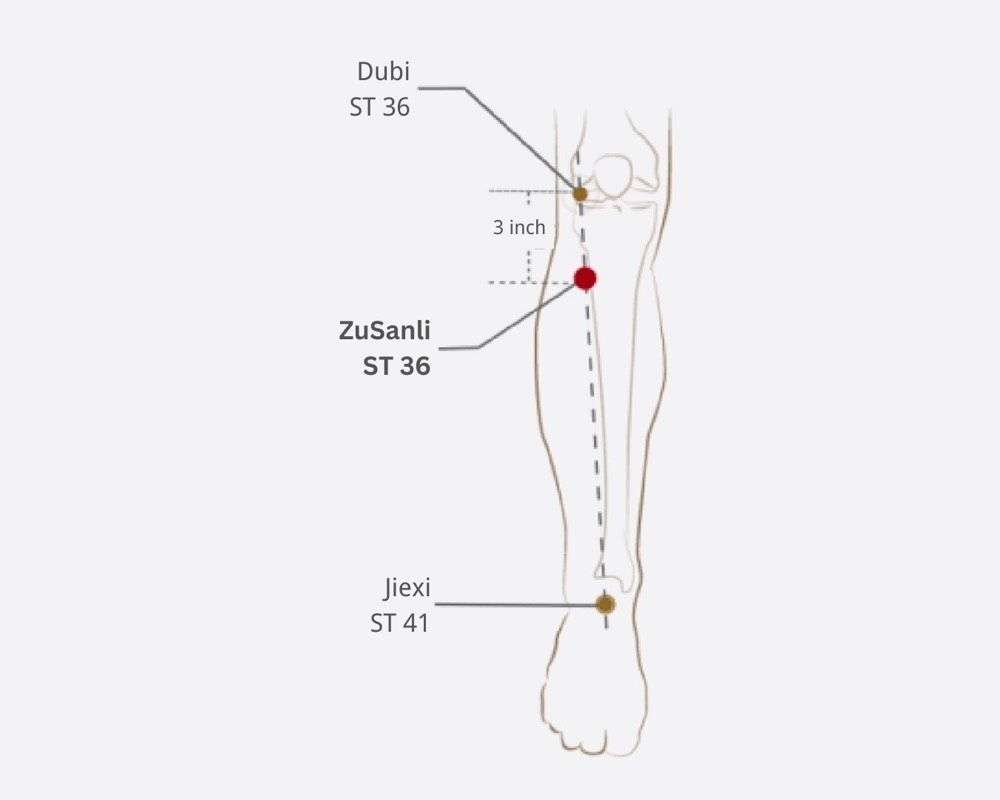
The point is Zusanli ST-36 ("Leg Three Li"), a hand-width below the kneecap and a thumb-width outside the shinbone, in the muscle rather than on the bone. In classical terms it is the lower uniting point of the Stomach, and the Lingshu chapter "Xie Qi Zang Fu Bing Xing" (《灵枢·邪气脏腑病形》) gives the rule that governs it: 合治内腑 — the uniting points are where the internal organs are reached.
Its reputation is deserved. It is the tradition’s central point for digestive strength and for building qi over time, which is why it appears in almost every self-care list ever written.
But classical practice never separated a point from its technique. The same location worked briskly and the same location worked gently do different things, and the tradition assumed a practitioner would choose based on whether the person in front of them had a surplus or a shortfall.
The Suwen chapter "Wu Chang Zheng Da Lun" (《素问·五常政大论》) makes the general principle unusually explicit: with strong methods, stop at six parts in ten rather than pushing on to ten. Restraint is written into the tradition, not added later for safety.
So when someone goes pale and yawns through a strong three-minute press, the classical reading is straightforward. Strong stimulation asks the system to spend, and a system without much in reserve feels the withdrawal immediately.
The gentler alternative I use most is Gongsun SP-4 ("Grandfather Grandson"), on the inner edge of the foot, in the hollow you find by sliding back along the arch from the base of the big toe. It supports the same digestive territory with far less demand, and it is much harder to overdo.
There is a second option that people rarely consider, which is to stop pressing altogether and use warmth instead. Classical practice regarded gentle sustained heat over this area as a supporting method in its own right, and for a depleted person it is often the better of the two.
None of this makes the point less valuable. It makes it a point with a dose, like everything else in the tradition, and the dose that suits a robust person in their thirties is not the dose that suits someone who is already running on empty.
What’s Real, What’s Myth
Myth: strong sensation means the point is working. Strong sensation means you pressed hard. The relationship between how much it hurts and how much it helps is not the straight line the internet suggests, and in depleted people the line runs the other way.
Myth: everyone should press this point daily for longevity. The tradition does hold it in high regard for long-term wellbeing, but "daily and hard" is a modern reading. Gentle, brief and regular fits the classical intent far better than long forceful sessions.
Myth: if you feel worse afterwards you must be releasing something. This is the idea I would most like to see retired. Feeling flat, dizzy or wiped out after point work means it was too much, and the correct response is to do less next time, not to push through.
Myth: more time is better. Three to five minutes of hard pressure is a lot for anyone. Thirty to sixty seconds of moderate pressure is a genuinely sufficient dose for most people, and it is the dose I start everyone on.
Real: the same point, worked gently and with warmth rather than force, suits depleted people well. It is not that the point is wrong for them — it is that the technique usually recommended is.
Five Things You Can Do This Week
1. Halve everything. Thirty to sixty seconds on each side, at a comfortable four or five out of ten, once a day. If that goes well for a week, you can consider a little more. Most people never need to.
2. Sit down and eat something first. Never do point work standing, on an empty stomach, or when you are already tired — that combination produces most of the light-headedness people report. Sitting, warm, and not hungry is the setting that suits this best.
3. Try the inner arch instead. Gongsun SP-4 ("Grandfather Grandson"), a minute of steady pressure each side while sitting, covers similar ground with far less demand. If the knee point reliably flattens you, start here for a fortnight.
4. Warm rather than press. A covered heat pack over the point below the knee for ten minutes, or brisk rubbing with the palm until the skin feels warm, delivers a supportive version of the same idea. This is the option I suggest most often for people who are genuinely depleted.
5. Walk for ten minutes after your evening meal. For a depleted digestive picture this does more than any point does, and it is the one item on this list I would keep if you kept only one.
When to See a Doctor
If you feel light-headed, sit or lie down immediately and stop. If you have actually fainted, or come close to it, that needs a GP appointment on its own — fainting is worth investigating properly and should not be filed under "the point was strong."
See your doctor promptly for dizziness that comes with chest discomfort, breathlessness, palpitations, or any weakness, numbness or speech change. Also for light-headedness on standing that has become a regular event, which has several ordinary explanations worth checking.
If you are frequently exhausted, pale, breathless on stairs or dizzy on standing, ask for basic blood work — iron, B12, thyroid function and blood sugar — before assuming this is a constitutional matter. In my experience this changes the picture often enough to be worth doing first.
Avoid firm pressure over any area that is swollen, red, hot, numb or recently injured, and speak to your doctor first if you have diabetes, neuropathy or circulation concerns in your legs. During pregnancy, check with your own registered practitioner before using either point described here.
Which Constitution This Usually Points To
Going light-headed, yawning and flat after strong point work is one of the clearer signs of a qi-deficient constitution (气虚质) — a system that does not have much spare capacity to spend. Everything in that pattern goes better with gentle, brief, frequent input rather than strong occasional input.
The same rule shows up elsewhere in this constitution. Exercise stops at a light sheen of sweat rather than a hard session, meals are warm and regular rather than long-fasted, and progress is measured in months rather than days.
If strong approaches reliably leave you worse rather than better, that is worth confirming. The quick assessment on this site walks you through 29 gentle questions in about three minutes and gives you a daily plan matched to your type, including how much stimulation actually suits you.
Watch: Jimmy explains this in the clinic
Keep Reading
Always Tired After Sleeping?
When a full night's rest still leaves you exhausted — the TCM view.
Read →Why Do I Sweat So Easily?
Daytime sweat, night sweats, sweaty palms — the TCM reading.
Read →When You Fit Two Types
Cold hands but mouth ulcers? Tired but wired? How to read a mixed constitution and what to work on first.
Read →The Classical Sweat Pair
Why one pair of points was used for both drenching sweat and no sweat at all — and how the direction changes.
Read →Late Autumn Burnout in Men
Why the same flat, heavy tiredness arrives every year around the same time — and what the classics said to do about it.
Read →Training Harder, Feeling Worse
When more sessions make you flatter, the low back is where the classics said to look first.
Read →Find Your Constitution
29 gentle questions, about three minutes, and you have your TCM body type — so this guidance actually fits you.
Take the quick quiz →Related
Learn about the Qi Deficiency constitution →Frequently Asked Questions
How do I know if I pressed too hard?
The tells are yawning partway through, feeling far away or light-headed, a sudden need to sit, or being noticeably flat for the rest of the day. Any one of those means halve the pressure and the time next session. A pleasant ache that fades within a few minutes is the response you are aiming for.
Is thirty seconds really enough?
For most people, yes, especially at the start. Classical practice cared about the right dose rather than the maximum one, and short regular sessions build far better than long forceful ones. You can always add a little once a fortnight has gone well.
Should I press this point before or after eating?
After, or between meals, but not when hungry. An empty stomach is when people most often go light-headed, and it is an easy thing to avoid. Sitting comfortably about half an hour after a meal is the setting I suggest.
Can I use warmth instead of pressure?
Yes, and for a depleted picture it often suits better. A covered heat pack over the area for ten minutes, or brisk palm rubbing until the skin is warm, delivers a supportive version of the same idea. Keep the heat comfortable rather than hot, and skip it entirely if you have reduced sensation in your legs.
Last updated: 2026-07-13
This page offers general TCM educational perspectives, not medical advice or a diagnosis. For any health concern, please consult a licensed healthcare professional.