The Point Pair Classical Doctors Used for Sweat — One Opens the Door, One Closes It
Two points, four hundred years of use, and a logic that explains why the same pair suits opposite problems.
Reviewed by Jimmy Yu, Certified Acupuncturist · Updated 2026-07-13
Quick answer
Classical texts pair Hegu LI-4 ("Joining Valley") in the web of the hand with Fuliu KI-7 ("Returning Current") above the inner ankle for problems with sweating. The pair works directionally: one point opens the surface and one closes it, so the same two locations suit both sweating too easily and not sweating at all.
Sweating While Sitting Still
Two people describe opposite problems in the same week. One sweats through a shirt sitting at a desk in a cool room, and finds it worst when tired. The other went through a whole summer and a hot yoga class barely damp, and feels blocked and stuffy because of it.
The first person usually adds an important detail once asked: the sweating is worse when they are run down, and afterwards they feel flatter than before. It is not exertion sweat. It arrives without being earned.
The second describes a different discomfort — heat that has nowhere to go, a stuffy head, skin that feels shut.
These sound like unrelated complaints. In classical practice they are two ends of the same mechanism, which is why the same two points appear in the old texts for both.
How Chinese Medicine Reads It
The Suwen chapter "Yin Yang Bie Lun" (《黄帝内经·素问·阴阳别论》) gives the definition in six characters
阳加于阴谓之汗
when yang acts upon yin, that is sweat. Warmth and activity meeting fluid and substance. Sweat, in this reading, is not waste; it is a product of the relationship between the two.
《黄帝内经·素问·阴阳别论》
The gatekeeper is wei qi, the defensive qi. The Lingshu chapter "Ben Zang" (《灵枢·本脏》) describes it as what "warms the flesh, fills the skin, and governs the opening and closing" of the surface — 司开阖者也. That last phrase is the whole story: opening and closing.
When wei qi is thin, the door does not close properly, and fluid escapes without being called for. That is the person sweating at rest, worse when tired, flatter afterwards. When the surface is blocked instead, the door does not open, and heat accumulates with nowhere to go.
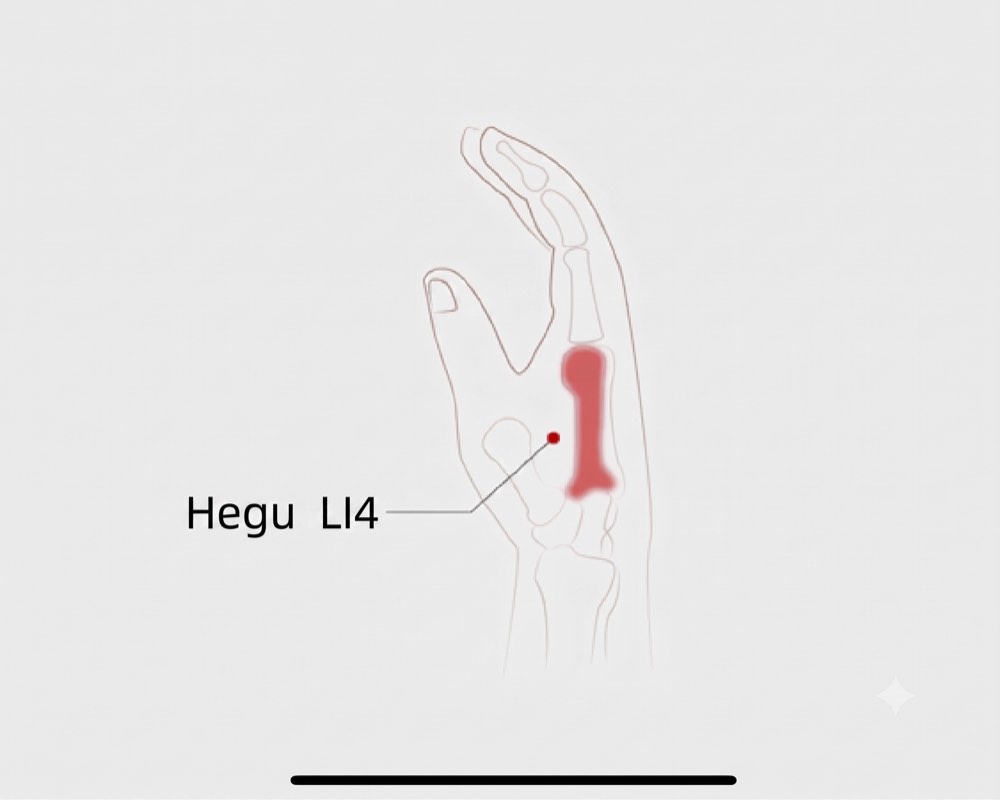
Hegu LI-4 ("Joining Valley") sits in the web between thumb and index finger, at the high point of the muscle when you bring them together. Fuliu KI-7 ("Returning Current") sits two thumb-widths above the tip of the inner ankle bone, just in front of the Achilles tendon.
The Ming compilation Zhenjiu Dacheng (《针灸大成》) records the pair with the direction attached: for absent sweat, drain at one and support the other; for excessive sweat, reverse it. The locations stay the same and the technique flips, which is why the pair survived for centuries as a single teaching.
For self-applied work you cannot replicate what a practitioner does in the clinic, but the directional idea still translates. Brisk, brief, stimulating pressure leans toward opening. Slow, sustained, warm pressure leans toward supporting and closing.
What’s Real, What’s Myth
Myth: sweating always means the body is releasing something it should. Sweat produced by effort in a robust person is one thing. Sweat that arrives at rest, or drenches you in your sleep, is described in the tradition as a leak rather than a release, and people generally feel worse rather than lighter afterwards.
Myth: sweating more is a good way to get rid of what you do not need. The classics take the opposite view — heavy sweating spends the same qi that holds the surface closed, which is why people who sweat hard while already depleted tend to catch every chill going around for the fortnight afterwards.
Myth: night sweats and day sweats are the same problem. Classical practice separates them clearly. Sweating during the day at rest points toward thin defensive qi; sweating in your sleep that stops when you wake points more toward yin depletion, and the two suit quite different approaches.
Myth: this hand point is safe for everybody. It is not. Hegu LI-4 is contraindicated in pregnancy, and the combination of Hegu LI-4 with Taichong LR-3 is avoided entirely during pregnancy. This is one of the firmest cautions in the tradition and worth repeating every time the point is mentioned.
Real: the pattern responds to sleep more than to anything you press. Defensive qi is rebuilt by rest, warm regular food and moderate exercise, and no point sequence compensates for a run of five-hour nights.
Five Things You Can Do This Week
1. Work out which side you are on first. Sweating at rest, worse when tired, feeling flatter afterwards is the leaking picture. Heat with no sweat at all and a stuffy, shut feeling is the closed picture. The steps below differ depending on the answer.
2. For sweating too easily: hold Fuliu KI-7 ("Returning Current") with slow steady pressure for two minutes each side, two thumb-widths above the inner ankle bone, in front of the Achilles tendon. Then rub the point warm with your palm. Keep the hand point light or skip it altogether.
3. For no sweat and a stuffy, blocked feeling: work Hegu LI-4 ("Joining Valley") briskly for thirty to sixty seconds each side, in the web between thumb and index finger. Not in pregnancy — skip it entirely, and skip it if you might be pregnant.
4. Stop your exercise at a light sheen. This is the single most useful habit for a leaking surface, and the hardest to persuade people of. When you finish, dry off and change immediately rather than cooling down in a damp shirt, and keep out of direct air conditioning or wind while your pores are still open.
5. Protect the back of the neck. In classical thinking the surface is most vulnerable there, and going straight from a warm room into cold wind with a damp neck is the classic way people end up unwell a day later. A collar or a light scarf is unglamorous and effective.
When to See a Doctor
Some sweating patterns need a medical assessment first, not a point routine. See your GP promptly for drenching night sweats that soak the bedding, particularly with fevers, unintended weight loss or new lumps. That combination is checked properly for good reason.
Book an appointment for sweating that started after a new medication, for sweating with palpitations, tremor, heat intolerance or unexplained weight change, and for sweating that comes with a persistent cough. Standard blood work covers most of the ordinary explanations.
Sweating with chest pain or pressure, breathlessness or nausea needs emergency care immediately. This is the one presentation where waiting to see is not a reasonable option.
For women in their forties and fifties, sweating and waves of heat with disturbed sleep are worth discussing with your GP, since there are effective options worth knowing about and it is not a matter you have to simply put up with.
Which Constitution This Usually Points To
Sweating at rest, worse when tired, alongside a soft voice, breathlessness on stairs and catching every chill going around points to a qi-deficient constitution (气虚质) with a thin defensive layer. Rebuilding is slow, gentle and consistent work rather than anything dramatic.
Sweating at night that stops on waking, with a dry mouth, warm palms and soles and a red tongue with little coating, points instead toward a yin-deficient constitution (阴虚质). That pattern needs nourishing rather than warming, and hot baths and heavy sweating suit it badly.
These two get confused constantly, and the approaches point in opposite directions. The quick assessment on this site walks you through 29 gentle questions in about three minutes and gives you a daily plan matched to your type, so you are not guessing between them.
Watch: Jimmy explains this in the clinic
Keep Reading
Always Tired After Sleeping?
When a full night's rest still leaves you exhausted — the TCM view.
Read →Why Do I Sweat So Easily?
Daytime sweat, night sweats, sweaty palms — the TCM reading.
Read →When You Fit Two Types
Cold hands but mouth ulcers? Tired but wired? How to read a mixed constitution and what to work on first.
Read →When the Famous Point Backfires
Light-headed and flat after pressing the point below your knee? The technique, not the point, is usually the problem.
Read →Late Autumn Burnout in Men
Why the same flat, heavy tiredness arrives every year around the same time — and what the classics said to do about it.
Read →Training Harder, Feeling Worse
When more sessions make you flatter, the low back is where the classics said to look first.
Read →Find Your Constitution
29 gentle questions, about three minutes, and you have your TCM body type — so this guidance actually fits you.
Take the quick quiz →Related
Learn about the Qi Deficiency constitution →Frequently Asked Questions
Can I use these points if I am pregnant?
No — Hegu LI-4 is contraindicated in pregnancy, and combining it with Taichong LR-3 is avoided entirely. If you are pregnant or might be, skip both and speak with your own registered practitioner. Gentle pressure at Fuliu KI-7 is generally considered milder, but check with your practitioner first rather than assuming.
Why do I feel worse after a heavy sweat at the gym?
In classical terms, heavy sweating spends the same qi that holds your surface closed, so a hard session can leave a depleted person flat and more prone to picking things up. Stopping at a light sheen, drying off promptly and staying out of cold air while your pores are open usually solves it.
What is the difference between day sweating and night sweating?
Sweating during the day at rest, worse with tiredness, points toward thin defensive qi. Sweating in your sleep that stops the moment you wake points more toward yin depletion, often with a dry mouth and warm palms and soles. They suit different approaches, so it is worth being clear which you have.
How long does it take to rebuild the defensive layer?
Longer than people hope — typically six to twelve weeks of consistent sleep, warm regular meals and moderate exercise. Points and food support that process rather than shortcut it. If nothing has changed in three months, have your doctor check the ordinary medical causes.
Last updated: 2026-07-13
This page offers general TCM educational perspectives, not medical advice or a diagnosis. For any health concern, please consult a licensed healthcare professional.