Your Body Is Exhausted and Your Head Won’t Stop — Where the Classics Send the Fire
Not a sleep problem so much as a direction problem. Something has gone up and has not come back down.
Reviewed by Jimmy Yu, Certified Acupuncturist · Updated 2026-07-13
Quick answer
Being physically exhausted while your mind races is read in Chinese medicine as heat that has risen and is not returning downward. The classical response is not to sedate the mind but to draw things back down through the lowest point of the body, which is why rubbing the soles works better than lying there trying harder.
Wired at Midnight, Wrecked at Seven
Your body has clearly had enough. You could not do another thing. And yet the moment the light goes off, your head starts up — a conversation from three days ago, tomorrow’s list, a decision from last year.
It has a particular quality that separates it from ordinary busy thinking. Not productive, not even coherent. Circling. The same four things in rotation, none of them resolving.
What often comes with it: a warm face and chest, a dry mouth, palms and soles that feel hot under the covers, and cold feet at the other end of the bed. That combination — hot above, cold below — is the clue this article is about.
And then the morning, which arrives with a headache and a strong sense of having been awake more than asleep.
How Chinese Medicine Reads It
The Lingshu chapter "Xie Ke" (《灵枢·邪客》) describes the Heart as
五脏六腑之大主也,精神之所舍也
the great governor of the organs, and the residence of the spirit. In this system the Heart is where the mind settles at night, and a mind that will not settle is described as a Heart that is not quiet.
《灵枢·邪客》
The Suwen chapter "Zhi Zhen Yao Da Lun" (《黄帝内经·素问·至真要大论》) supplies the mechanism
诸躁狂越,皆属于火
restlessness and agitation all relate to fire. Fire rises. That is its nature, and it is why this pattern feels like something is up in your head and chest while your feet stay cold.
《黄帝内经·素问·至真要大论》
The important distinction is what kind of fire. Full, excess heat comes with a red face all day, a bitter taste, constipation and a thick yellow tongue coating. What most people with this pattern have instead is empty fire — heat that appears not because there is too much warmth but because the cooling side of the body has run low, so ordinary warmth is no longer balanced.
That distinction changes everything about what helps. You cannot settle empty fire by attacking it. The classical instruction, from Wang Bing’s commentary on the Neijing, is 壮水之主,以制阳光 — strengthen the source of water in order to moderate the sun.
The practical version of that at bedtime is 引火归元 — drawing the fire back to its source. Give warmth and attention to the lowest point of the body and what has risen tends to follow it down.
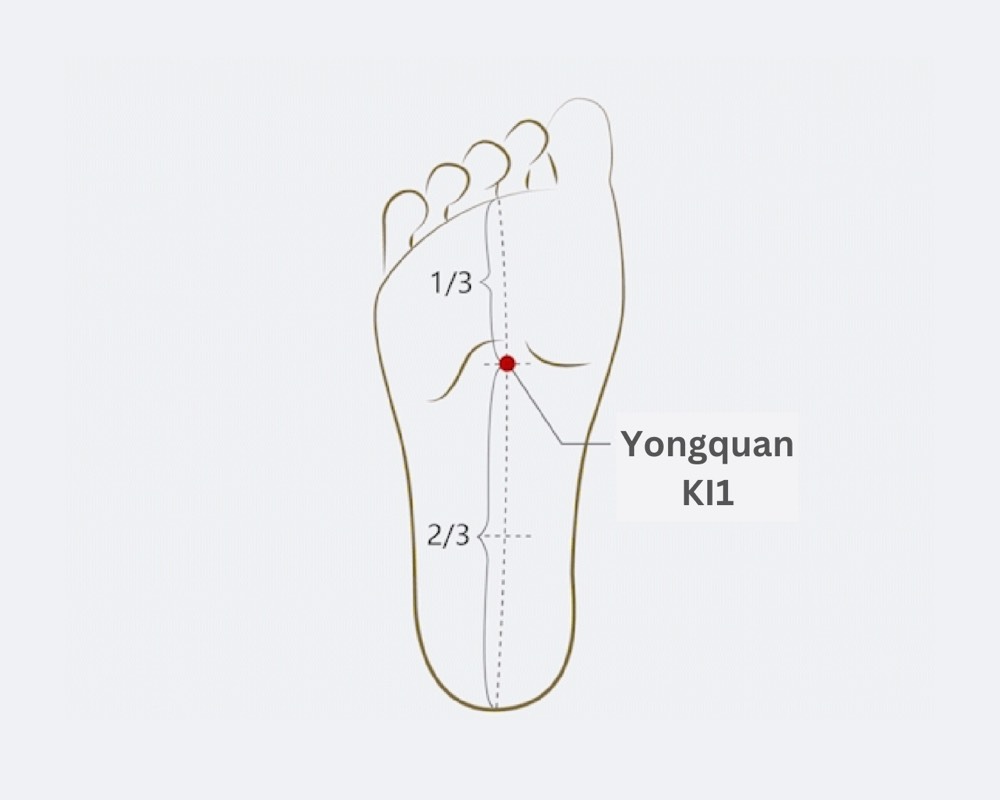
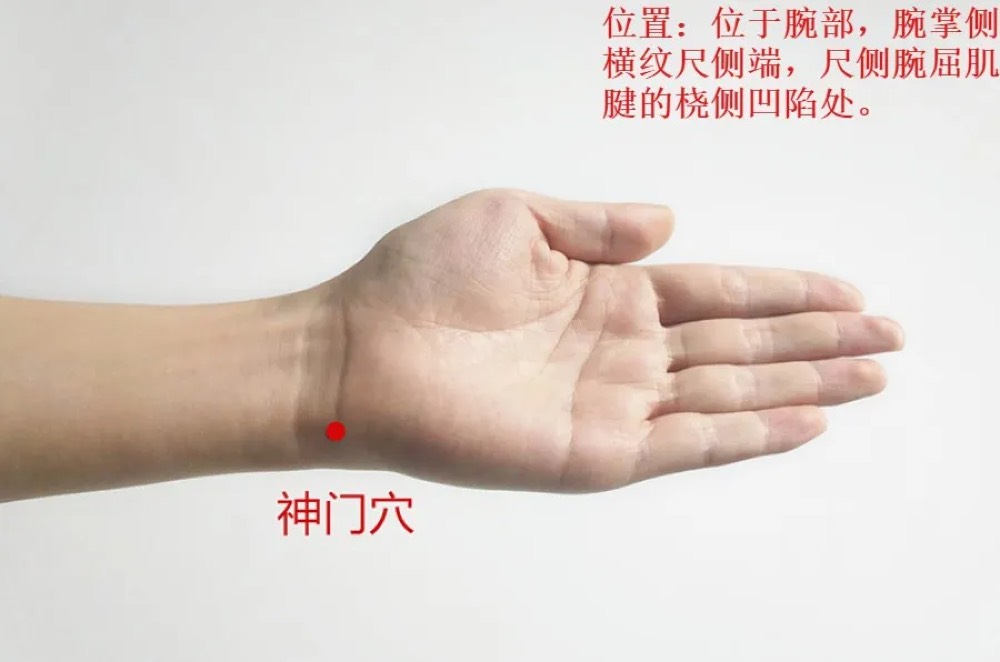
Yongquan KI-1 ("Bubbling Spring") is the point this works through: in the hollow on the sole, about a third of the way down from the toes, in the dip that appears when you curl your foot. Its name describes a spring at the lowest point, which is exactly the idea. Shenmen HT-7 ("Spirit Gate") sits on the wrist crease on the little-finger side, in the hollow beside the tendon. Taixi KI-3 ("Great Ravine") sits between the inner ankle bone and the Achilles tendon.
What’s Real, What’s Myth
Myth: you need to calm your mind down. In this framework the mind is downstream, not upstream. Trying harder to stop thinking at midnight is the least effective intervention available, and most people have already spent months proving that to themselves.
Myth: cooling things down will help. If the heat is empty rather than full, cold drinks and cooling foods give twenty minutes of relief and then leave you where you were — while quietly undermining the digestion that produces the substance you are short of. This is the single most common wrong turn in this pattern.
Myth: a hot bath before bed is relaxing for everyone. For this picture it often backfires, since heavy sweating spends exactly the fluid that is already low. Warm rather than hot, feet rather than whole body, and finishing before you sweat.
Myth: if you cannot sleep you should get up and do something useful. Opening a laptop at midnight entrenches the pattern. If you do get up, keep it dim, warm, and screen-free, and go back when sleepy.
Real: the feet are the lever. Of everything in this article, brisk rubbing of the soles is the item people report back on. It takes two minutes, it feels like it should not do anything, and for this particular pattern it does more than anything you can take.
Six Things to Do in the Evening
1. Soak your feet at 38–40°C (100–104°F) for ten to fifteen minutes, half an hour before bed. Warm, not hot, and stop well before you sweat. A tablespoon of ordinary salt suits this pattern; ginger does not, since you are not short of warmth.
2. Rub Yongquan KI-1 ("Bubbling Spring") for two minutes on each sole. Thumb into the hollow a third of the way down from the toes, brisk circular rubbing until the sole is genuinely warm. This is the central item here, and two minutes is not the same as thirty seconds.
3. Hold Shenmen HT-7 ("Spirit Gate") for a minute each side. On the wrist crease on the little-finger side, in the hollow beside the tendon. Gentle steady pressure while you breathe out slowly.
4. Add Taixi KI-3 ("Great Ravine") for a minute each side, in the hollow between the inner ankle bone and the Achilles tendon. Gentle and sustained — force is the wrong direction for a pattern defined by shortage.
5. Be in bed before eleven, five nights out of seven. In classical timing the late-night hours are when the cooling side of the body is restored, so staying up past midnight spends exactly what you are trying to rebuild. This is the item with the largest long-term effect and the one most resisted.
6. Write the circling thoughts down before ten. Not a journal — a list, on paper, of whatever is going to come back at midnight. Unglamorous, and it removes about half of what would otherwise be in rotation.
When to See a Doctor
See your GP if sleep has been poor for more than a month, if you are exhausted through the day, or if you have been using alcohol or sleeping tablets to get through. Cognitive behavioural therapy for insomnia is more effective than most people realise and is worth asking about by name.
Book an appointment for a racing heart, palpitations that wake you, tremor, unexplained weight loss or heat intolerance — ask about thyroid function, which produces this exact combination of exhaustion and agitation. Also for any new symptom that began after starting a medication.
Sleep apnoea is worth ruling out even here: if you snore loudly, if anyone has noticed you stop breathing, or if you fall asleep easily during the day, ask about a sleep study.
And plainly, because this pattern often sits alongside it: if the circling thoughts are anxious rather than merely busy, if you are having panic attacks, if your mood has been low most days for a fortnight, or if you have any thoughts of harming yourself, please speak to your GP or a mental health professional. This article describes a body pattern, and it sits alongside that care rather than replacing it.
Which Constitution This Usually Points To
A racing mind with warm palms and soles, a dry mouth, light dreamy sleep, heat that is worst in the late afternoon and at night, and a red tongue with little coating points toward a yin-deficient constitution (阴虚质). The rule for this pattern is to nourish rather than to clear — and hot baths, saunas and heavy sweating all work against it.
If the mind is racing with irritability, a tight jaw and tight ribs, and the pattern tracks with your workload rather than with the time of year, qi stagnation (气郁质) is leading, and brisk daily walking does more than anything you do at bedtime.
If the exhaustion dominates and the thinking is more foggy than racing, a qi-deficient constitution (气虚质) is underneath, and the plan is building rather than settling.
The quick assessment on this site walks you through 29 gentle questions in about three minutes and gives you a daily plan matched to your type, including whether your evening routine should be warming or nourishing.
Keep Reading
Jittery, Not Strong
When the double espresso before training makes your hands shake and your legs weak.
Read →Hot Shower, No Sleep
Why a scalding shower before bed leaves some people wide awake — and what temperature suits instead.
Read →Gritty Eyes by Four
Why eye drops help for twenty minutes — and what the classics say is actually running low.
Read →When Creams Stop Working
Dry skin, dull complexion and flat energy after a demanding decade — what the classics said changes at thirty-five.
Read →Heat That Isn’t Heat
Warm palms and night heat that ice water does not touch — and the classical reason why.
Read →Dry From Indoor Heating?
The heated-room desert, the inside-out fix, and the two kinds of dryness that need a doctor.
Read →Find Your Constitution
29 gentle questions, about three minutes, and you have your TCM body type — so this guidance actually fits you.
Take the quick quiz →Related
Learn about the Yin Deficiency constitution →Frequently Asked Questions
Why do my feet stay cold while my head feels hot?
That is the signature of this pattern — something has risen and is not returning downward. It is not two separate problems. Warming and rubbing the soles addresses the direction rather than either end, which is why it works better than socks alone or than anything aimed at the head.
How long should I rub the soles?
Two minutes each side, briskly, until the sole feels genuinely warm rather than merely touched. Thirty seconds does very little. Rubbing the soles against each other under the covers works too if you would rather not sit up.
Should the foot soak be hot?
No — warm, at 38–40°C, and stopping before you sweat. Hot water and heavy sweating spend the fluid that is already low in this pattern, which is why some people feel hotter at night after a hot bath. Add salt rather than ginger here.
How long before nights change?
Many people notice falling asleep faster within the first week, mostly from the foot work. The underlying pattern — night heat, dry mouth, light dreamy sleep — takes six to eight weeks, and the bedtime before eleven is what moves it. If nothing shifts in two months, see your GP.
Last updated: 2026-07-13
This page offers general TCM educational perspectives, not medical advice or a diagnosis. For any health concern, please consult a licensed healthcare professional.