The Ten-Minute Habit That Ends the Day — Why Warm Feet Settle Everything Above Them
The most widely used home practice in the tradition, and the one most often done at the wrong temperature.
Reviewed by Jimmy Yu, Certified Acupuncturist · Updated 2026-07-13
Quick answer
An evening foot soak is the tradition’s standard way of drawing energy downward before sleep. Temperature matters and differs by pattern: warm 38–40°C for a dry or yin-deficient picture, up to 40–42°C with ginger for a heavy, damp one. Stop before you sweat, and dry thoroughly afterwards.
Warm Body, Cold Feet, No Sleep
It is a particular kind of frustration. You are warm enough under the covers, tired enough to sleep, and your feet are cold, and nothing above them will settle until they are not.
The variations are familiar. Feet that never warm up in winter. A head that stays busy at eleven while the feet stay cold. Restless legs in the evening, or the sense that everything has risen upward — warm face, active mind, cold extremities.
In China this has an unremarkable answer that most households do without thinking about it: a basin of warm water before bed. It is the most widely practised home habit in the tradition and it costs nothing.
It is also the one most often done wrong, and the errors are simple — too hot, too long, or right before bed with wet feet going straight under the covers.
How Chinese Medicine Reads It
The Suwen chapter "Si Qi Tiao Shen Da Lun" (《黄帝内经·素问·四气调神大论》) describes winter as 闭藏 — shutting and storing — and advises sleeping early, rising with the sun, and keeping warm without provoking heavy sweating. The last clause is the one that matters here.
The classical concern in the evening is direction. Through the day, energy is described as active and upward; at night it should settle downward and inward. When it does not, you get the exact picture people describe — a busy head, a warm face and cold feet.
The tradition’s phrase for correcting this is 引火归元, drawing the fire back to its source. In practice that means giving warmth to the lowest part of the body so that everything above it follows.
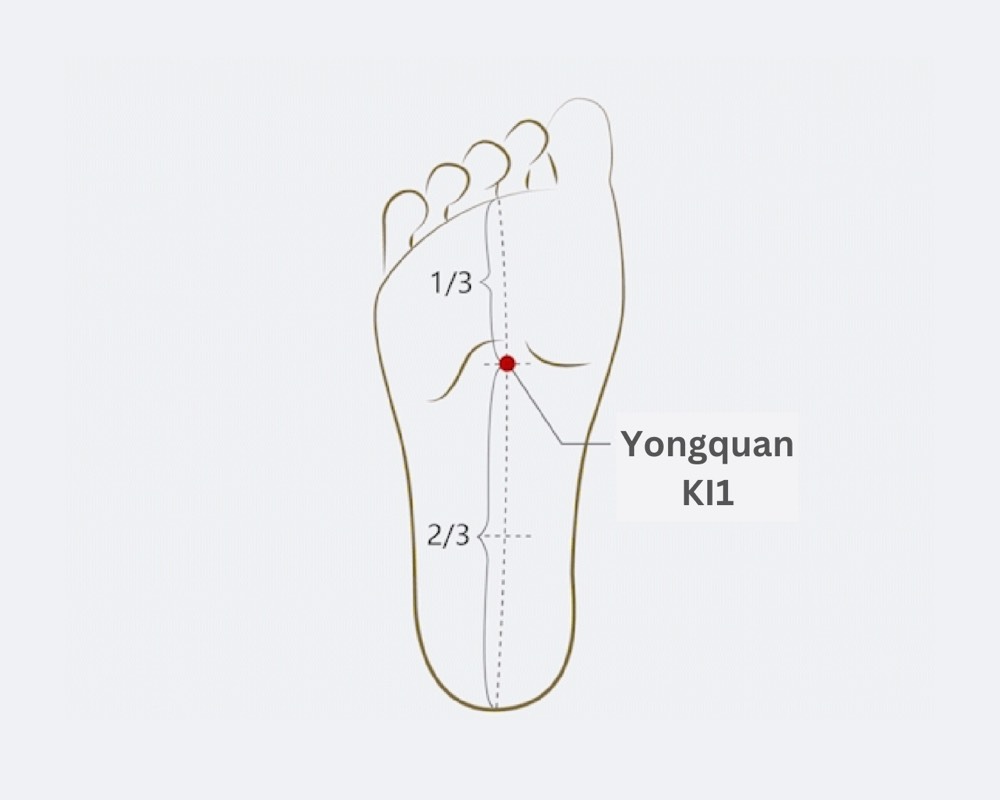
Yongquan KI-1 ("Bubbling Spring") is the point this works through — in the hollow on the sole, about a third of the way down from the toes, in the dip that appears when you curl your foot. Its name describes a spring at the lowest point, which is precisely the idea.
Two other points sit within reach of the same basin. Taixi KI-3 ("Great Ravine") is between the inner ankle bone and the Achilles tendon. Sanyinjiao SP-6 ("Three Yin Intersection") is four finger-widths above the inner ankle bone — and must not be used during pregnancy.
Temperature is where the tradition is more specific than most people realise, because it differs by pattern. A cold, yang-deficient person tolerates and benefits from warmer water. A dry, yin-deficient person must keep it warm rather than hot, because heavy sweating spends exactly what they are short of.
What’s Real, What’s Myth
Myth: hotter is better. This is the most common error. Water hot enough to make you sweat undoes the purpose, and in a dry or depleted person it leaves them warmer at night and flatter the next day. Warm and comfortable, stopping before sweat, is the instruction across the whole tradition.
Myth: longer is better. Ten to fifteen minutes is the standard. Thirty minutes in cooling water is worse than ten in properly warm water, and long soaks soften the skin more than they help anything.
Myth: it needs herbs to be worth doing. Plain warm water does most of the work. Fresh ginger suits a cold or damp picture, and a spoonful of ordinary salt suits a dry one. Complicated additions are optional and generally overrated.
Myth: do it immediately before getting into bed. Half an hour before is better, and dry your feet thoroughly and put socks on afterwards. Damp feet going straight under a duvet cool down again quickly, which is the opposite of the intention.
Real: this is one of the few practices where nearly everyone reports something. In my clinic it is the habit with the highest completion rate of anything I suggest, because it takes ten minutes, requires no equipment, and people feel the difference the first week.
How to Do It, by Pattern
1. The basic version. Water to just above the ankle bones, ten to fifteen minutes, half an hour before bed. Stop before you sweat. Dry thoroughly, socks on, then bed. That is the whole practice and it suits almost everyone.
2. If you run cold — cold low back, cold knees, hot drinks all year: 38–40°C (100–104°F), with three or four slices of fresh ginger. Rub the soles briskly afterwards to finish.
3. If you are heavy and damp — thick tongue coating, foggy mornings, worse in humid weather: 40–42°C (104–108°F) with fresh ginger, ending before you sweat. This is the warmest version in the tradition and it belongs to this pattern specifically.
4. If you run dry with night heat — warm palms and soles, dry mouth, light dreamy sleep: 38–40°C (100–104°F) only, never hot, with a tablespoon of ordinary salt. Stop well before any sweating. For this pattern hot water is actively the wrong direction.
5. Finish at Yongquan KI-1 ("Bubbling Spring"). Rub the hollow on each sole briskly with your thumb for a minute, or rub the soles against each other. This is the step that makes the difference between a nice foot bath and the classical practice.
6. Add Taixi KI-3 ("Great Ravine") for a minute each side while your feet are still warm. If you want to include Sanyinjiao SP-6, note that it is contraindicated in pregnancy and skip it entirely if there is any chance you are pregnant.
When to See a Doctor
This practice has real contraindications and they are worth taking seriously. If you have diabetes, peripheral neuropathy, or any reduced sensation in your feet, do not use hot water and speak with your doctor first — you cannot feel a burn coming, and foot burns in that situation are serious.
Avoid foot soaks entirely if you have open wounds, ulcers, active infection or broken skin on your feet, and if you have peripheral arterial disease or any circulation problem in your legs, check with your doctor before starting. Always test the water with your hand or a thermometer rather than your feet.
See your GP for feet that are persistently cold and pale or blue, for cramping in your calves when walking that eases with rest, for numbness or tingling that is new, or for any foot wound that is slow to heal.
If cold feet are new or have clearly worsened, ask for basic blood work — thyroid function, iron and ferritin, B12 and blood sugar. And if you have not slept well for more than a month, or wake at the same time every night, that is worth discussing rather than only adding habits.
Which Constitution This Usually Points To
Cold feet that will not warm, alongside a cold lower back and knees, a preference for hot drinks all year and waking at night to pass urine, point toward a yang-deficient constitution (阳虚质). This practice suits that pattern about as well as anything in the tradition, and the ginger belongs in the water.
If the cold feet come with a warm face, warm palms, a dry mouth and light dreamy sleep, a yin-deficient constitution (阴虚质) is the reading, and the temperature must stay warm rather than hot. Same practice, different setting — and getting it wrong makes the nights worse.
If heaviness and a thick tongue coating dominate, a phlegm-damp constitution (痰湿质) leads, and the warmest version with ginger is the one that suits.
The quick assessment on this site walks you through 29 gentle questions in about three minutes and gives you a daily plan matched to your type, including the water temperature that actually suits you.
Keep Reading
Why Am I Always Cold?
The TCM take on cold hands, cold feet, and never feeling warm.
Read →Always Cold: Qi or Yang?
How to tell whether your cold hands and feet come from thin qi or from low inner warmth — and what each one asks for.
Read →The Iced Coffee Question
Why four cold brews a day flatten some men and not others — and the swaps that cost you nothing.
Read →Ice Baths After Forty
Why the same cold plunge sharpens one man and flattens another — and how to tell which you are.
Read →Long Hours Sitting
What eight hours in a seat does below the waist — and the three-minute habit that answers it.
Read →Cold Feet, No Sleep
Why you lie awake for an hour with warm shoulders and freezing feet — and the ten-minute answer.
Read →Find Your Constitution
29 gentle questions, about three minutes, and you have your TCM body type — so this guidance actually fits you.
Take the quick quiz →Related
Learn about the Yang Deficiency constitution →Frequently Asked Questions
What temperature should the water be?
Between 38 and 42°C (100–108°F) depending on your pattern — warmer for a cold or damp picture, and 38–40°C only for a dry, yin-deficient one. Comfortably warm rather than hot is the general rule, and stopping before you sweat matters more than the exact number.
How long and how often?
Ten to fifteen minutes, three to five evenings a week, about half an hour before bed. Every night is fine if it suits you. Longer than twenty minutes adds nothing and softens the skin more than it helps.
Can I use a foot spa or the bath instead?
A basin or a foot spa both work, and a foot spa saves refilling. A full bath is a different thing — it is more demanding and it heats the whole body, which is exactly what a dry, yin-deficient person should avoid before bed. For this purpose, feet only is the point.
Who should not do this?
Anyone with diabetes, neuropathy or reduced sensation in the feet without speaking to their doctor first; anyone with open wounds, ulcers or infection on the feet; and anyone with known circulation problems in the legs. In pregnancy, keep the water warm rather than hot and skip Sanyinjiao SP-6 entirely.
Last updated: 2026-07-13
This page offers general TCM educational perspectives, not medical advice or a diagnosis. For any health concern, please consult a licensed healthcare professional.