Worry Sits in Your Stomach — Why Overthinking Slows Your Digestion Down
The Neijing pairs each emotion with an organ. Overthinking got paired with the digestion, and it shows.
Reviewed by Jimmy Yu, Certified Acupuncturist · Updated 2026-07-13
Quick answer
The Neijing pairs overthinking with the Spleen, the system that governs digestion, and says overthinking knots the qi. That is why bloating, appetite loss and a heavy middle track with your worries rather than with what you ate, and why food changes alone rarely resolve them.
A Stomach That Knows What Week It Is
People describe a knot. Not pain exactly — a tightness or fullness under the breastbone that arrives with a difficult stretch and leaves when it does.
Around it, the familiar cluster: appetite that disappears when things are stressful, then returns with interest at nine in the evening. Bloating by mid-afternoon regardless of lunch. A meal that sits like a stone on the days you ate it at your desk while working.
The detail that identifies it is the correlation. The same lunch is fine in a good week and a problem in a bad one. People try eliminating foods one at a time for months before noticing that the variable is not on the plate.
And the one nobody volunteers until asked: it is worse when you are chewing over something you cannot resolve. Not busy — circling.
How Chinese Medicine Reads It
The Suwen chapter "Yin Yang Ying Xiang Da Lun" (《黄帝内经·素问·阴阳应象大论》) pairs each emotion with an organ system, and the pairing for the Spleen is unambiguous
在志为思,思伤脾
its emotion is thought, and overthinking harms the Spleen.
《黄帝内经·素问·阴阳应象大论》
The Spleen in this system is not the anatomical organ. It is the whole capacity to turn food into usable energy — the warm pot over a steady flame that everything else in the tradition’s food thinking depends on.
The Suwen chapter "Ju Tong Lun" (《素问·举痛论》) gives the mechanism in three characters: 思则气结 — overthinking knots the qi. Knots. Not depletes, not heats. Something that was moving stops moving, and it stops in the middle of the body.
That is a remarkably specific claim to find in a two-thousand-year-old text, and it matches what people describe almost exactly: a knot under the breastbone, food that sits, a middle that feels tight rather than sore.
There is a second mechanism worth knowing, because it explains why irritability and bloating so often arrive together. Zhang Zhongjing wrote in the Jingui Yaolue (《金匮要略》)
见肝之病,知肝传脾,当先实脾
when the Liver is disordered, expect it to pass to the Spleen, so support the Spleen first. Constraint from frustration presses sideways into the digestion.
《金匮要略》
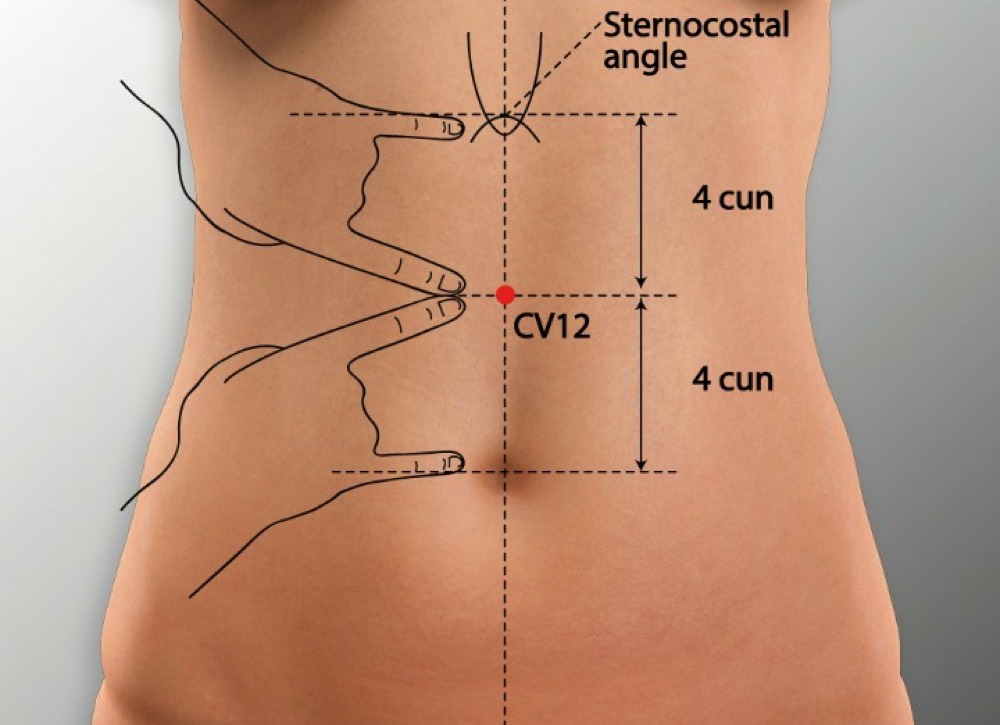
The points reflect both halves. Zusanli ST-36 ("Leg Three Li") sits a hand-width below the kneecap and a thumb-width outside the shinbone, supporting the digestion directly. Zhongwan CV-12 ("Middle Cavity") sits midway between the navel and the base of the breastbone, over the stomach itself. Neiguan PC-6 ("Inner Pass") sits three finger-widths above the wrist crease, between the two tendons, and is the classical point for the chest and upper abdomen together.
What’s Real, What’s Myth
Myth: bloating that comes and goes must be a food intolerance. A genuine intolerance is fairly consistent — the same food produces roughly the same result whatever week it is. If the same lunch is fine in January and a problem in March, the food is not the variable, and eliminating one thing at a time is a long road to a narrower diet and no more energy.
Myth: it is all in your head, so it is not real. The knot is real, the bloating is real, and the tradition described the mechanism before anyone had a word for the gut-brain axis. What the pattern view adds is a route to act on it that does not require you to stop worrying first.
Myth: you need to relax more. Rest suits a depletion pattern. This is partly a knotting pattern, and knots respond to movement — a ten-minute walk after a meal does more than an evening on the sofa. It is also more achievable, which matters.
Myth: eating while working is neutral. It is one of the more reliable contributors here. In this framework the digestion is a warm process that needs attention and blood supply, and a meal eaten in twelve minutes while answering emails is asking for it while the system is engaged elsewhere.
Real: how you eat matters as much as what you eat for this pattern. Twenty minutes at a table, no screen, finishing comfortable rather than full. That single change resolves more mid-afternoon bloating in my clinic than any elimination diet.
Six Things You Can Do This Week
1. Eat away from your desk, for two weeks. Twenty minutes, sitting, no screen. This is the least interesting item and the one with the largest effect on this particular pattern.
2. Walk for ten minutes after your evening meal. Movement after eating is described in the tradition as what keeps the process moving, and it is the most reliably kept habit I suggest.
3. Press Zusanli ST-36 ("Leg Three Li") for a minute each side, sitting, about half an hour after a meal. Moderate steady pressure, never on an empty stomach.
4. Warm the middle when it is knotted. A warm palm or covered heat pack over Zhongwan CV-12 ("Middle Cavity") for five to ten minutes, midway between navel and breastbone. Then hold Neiguan PC-6 ("Inner Pass") for a minute each side, breathing out slowly.
5. Add chenpi (陈皮, aged tangerine peel) to anything rich, and keep a small pot of it as afternoon tea. A thumbnail piece in hot water. This is the classical companion for a middle that feels distended rather than sore.
6. Give the circling somewhere to go before dinner. Ten minutes of brisk walking or five minutes writing the unresolved thing down. In this framework you are not trying to stop thinking — you are trying to stop it accumulating in one place.
When to See a Doctor
Some digestive symptoms need assessment rather than a pattern reading. See your GP promptly for unintended weight loss, blood in your stool or black stools, difficulty or pain on swallowing, persistent vomiting, or abdominal pain that is severe, new, or waking you at night.
Book an appointment for a change in bowel habit lasting more than three weeks, particularly over fifty, and for bloating that is persistent rather than fluctuating. In women, persistent bloating with abdominal or pelvic discomfort should always be assessed. Ask about coeliac disease if symptoms are consistent regardless of the week.
Reflux or upper abdominal burning several times a week, especially if you have been medicating it for months, is worth reviewing rather than continuing indefinitely.
And on the other side: if worry is affecting your sleep, work or relationships, if you are having panic attacks, or if your mood has been low most days for a fortnight, please speak to your GP or a psychologist. Anxiety that shows up in the stomach is still anxiety, and it responds well to proper support alongside anything described here.
Which Constitution This Usually Points To
Bloating, tiredness after eating, appetite that disappears under pressure, a soft voice and breathlessness on stairs point toward a qi-deficient constitution (气虚质) with a weak digestive flame. For this pattern the order is fixed: stop the drain first — eating at a desk, skipping meals, cold breakfasts — then build.
If irritability, tight ribs and a short fuse lead the picture and the bloating follows them, qi stagnation (气郁质) is upstream, and brisk walking matters more than any food change.
If heaviness with a thick greasy tongue coating dominates, a phlegm-damp constitution (痰湿质) is leading, and reducing sweet and fried food matters as much as how you eat.
The quick assessment on this site walks you through 29 gentle questions in about three minutes and gives you a daily plan matched to your type, including where to put your effort first.
Keep Reading
Always Tired After Sleeping?
When a full night's rest still leaves you exhausted — the TCM view.
Read →Why Do I Sweat So Easily?
Daytime sweat, night sweats, sweaty palms — the TCM reading.
Read →When You Fit Two Types
Cold hands but mouth ulcers? Tired but wired? How to read a mixed constitution and what to work on first.
Read →When the Famous Point Backfires
Light-headed and flat after pressing the point below your knee? The technique, not the point, is usually the problem.
Read →The Classical Sweat Pair
Why one pair of points was used for both drenching sweat and no sweat at all — and how the direction changes.
Read →Late Autumn Burnout in Men
Why the same flat, heavy tiredness arrives every year around the same time — and what the classics said to do about it.
Read →Find Your Constitution
29 gentle questions, about three minutes, and you have your TCM body type — so this guidance actually fits you.
Take the quick quiz →Related
Learn about the Qi Deficiency constitution →Frequently Asked Questions
How do I tell this from a food intolerance?
Look at consistency. An intolerance produces roughly the same result from the same food regardless of the week. This pattern produces a different result from the same meal depending on what else is going on. Keeping a two-column note — what you ate, and what kind of week it was — usually settles it within a fortnight.
Why does my appetite disappear when I am stressed and come back at night?
In this framework the knotting is at its tightest while the pressure is on, and it releases when the day does. That is why so many people eat very little until eight and then a great deal at nine. Eating a proper lunch away from your desk usually flattens the whole curve.
Does this mean I have to fix my stress first?
No, and that framing tends to leave people stuck. The practical entry points are how and when you eat, and a walk after meals — all of which you can change this week regardless of what is happening at work. The digestion usually settles before the circumstances do.
How long before the bloating changes?
Most people notice a difference in the mid-afternoon within one to two weeks, mainly from eating away from the desk. If two weeks of that changes nothing at all, the variable is elsewhere and it is worth seeing your GP rather than narrowing your diet further.
Last updated: 2026-07-13
This page offers general TCM educational perspectives, not medical advice or a diagnosis. For any health concern, please consult a licensed healthcare professional.