The Point Where Three Channels Meet — A Three-Minute Evening Habit Worth Keeping
One of the most used points in the tradition, and the one with the firmest safety rule attached.
Reviewed by Jimmy Yu, Certified Acupuncturist · Updated 2026-07-13
Quick answer
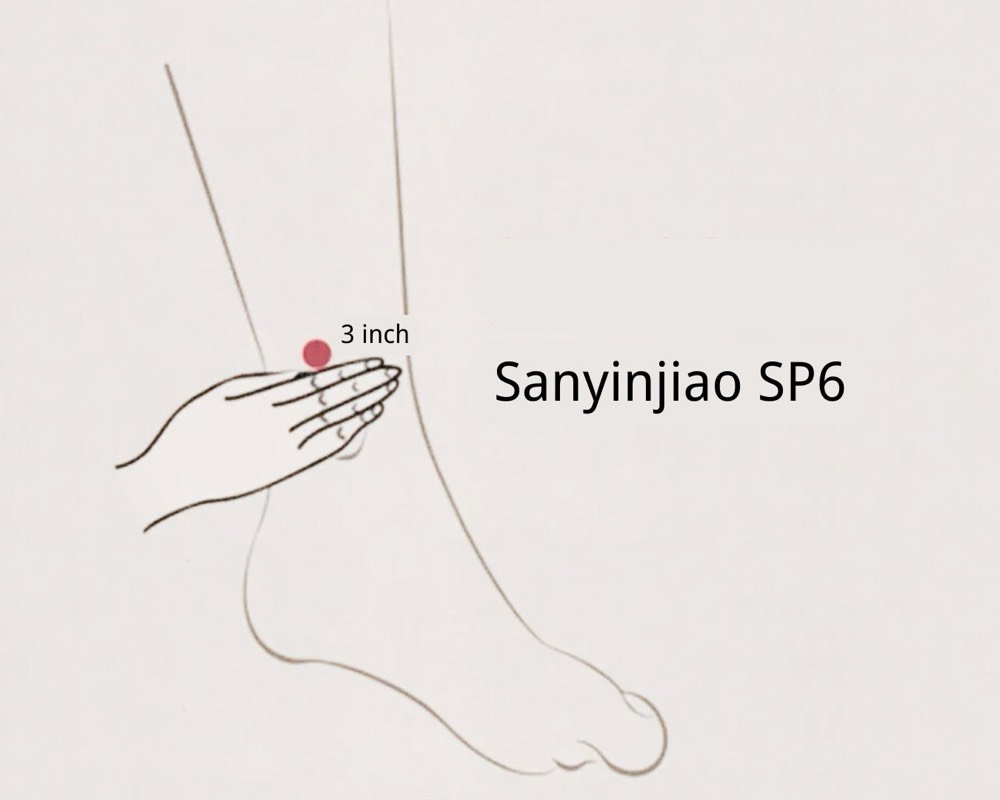
Sanyinjiao SP-6 ("Three Yin Intersection") sits four finger-widths above the inner ankle bone, where three channels cross. Classical practice used it as a single access point for all three, which is why it appears in so many evening routines for women. It must not be used during pregnancy.
The Ankle Point Everyone Has Heard Of
Most women who come in having read anything about Chinese medicine have heard of this point. Fewer can find it accurately, and fewer still know the one rule that matters most about it.
The complaints that bring people to it are recognisable. Sleep that comes slowly because the mind will not settle. Feet that stay cold in bed. A cycle that has become less predictable, or a week before it that no longer feels like your own.
What people usually report after a fortnight of doing it properly is unglamorous and specific: falling asleep faster, and feet that are warm by the time they do.
Before anything else, the safety rule, because it is the most important sentence in this article. This point must not be used during pregnancy. If you are pregnant or might be, stop here and use the breathing and the warm foot soak instead.
How Chinese Medicine Reads It
The point is Sanyinjiao SP-6 ("Three Yin Intersection"), and its name is a plain description of the anatomy. It is where the Spleen, Liver and Kidney channels cross on the inner lower leg — three of the body’s six yin channels meeting at one place.
To find it, place four fingers together across your inner ankle with the little finger resting on the top of the ankle bone. The point sits just above your index finger, right at the back edge of the shinbone, and it is usually tender enough that you know when you have it.
The Zhenjiu Jiayijing (《针灸甲乙经》), compiled by Huangfu Mi in the third century, is the text that fixed the classical point locations and their crossings, and this one has been used continuously since.
Why the tradition made so much of it is straightforward once you see which three channels meet there. The Spleen governs turning food into blood. The Liver stores blood and governs its smooth movement. The Kidneys hold the deep reserve. Those three are the whole account of a woman’s blood in classical terms — one point, three doors.
The Suwen chapter "Shang Gu Tian Zhen Lun" (《黄帝内经·素问·上古天真论》) maps women’s development in cycles of seven years, noting at 五七 — thirty-five — that the yangming channel begins to weaken, the complexion starts to dull and the hair begins to thin. The classics presented these as ordinary transitions worth supporting rather than problems appearing from nowhere.
Two companions round out the evening. Taixi KI-3 ("Great Ravine") sits between the inner ankle bone and the Achilles tendon. Taichong LR-3 ("Great Surge") sits on the top of the foot in the groove between the first and second bones, for the evenings when the day is still running in your head.
What’s Real, What’s Myth
Myth: this point is safe for everyone because it is gentle. It is not, and this is the myth that matters. Sanyinjiao SP-6 is contraindicated in pregnancy — the tradition is unambiguous about it, and no amount of gentleness changes that. If you are pregnant, trying to conceive and possibly already pregnant, or unsure, do not use it.
Myth: pressing it harder gets more from it. This point is often tender, and tenderness tempts people into force. A firm, comfortable ache held for a minute or two does more than grinding into it, and the women who report feeling drained afterwards are almost always the ones who pressed hardest.
Myth: it will regulate your cycle on its own. It supports the system the tradition associates with the cycle; it is not a substitute for looking at sleep, food, iron levels and stress, and it is not a substitute for medical assessment when a cycle changes markedly. Anything that has changed suddenly needs a doctor before it needs a routine.
Myth: do it right before you get into bed for the best effect. Half an hour before bed generally works better. Doing it in bed with cold feet under a duvet gives the warmth nowhere to go — a warm foot soak first, then the point, then bed, is the sequence people report most from.
Real: the tenderness itself changes over time. Many women find the point sharply sore in the first fortnight and considerably less so by the second month. It is one of the more useful self-tracked markers in the whole tradition.
The Three-Minute Evening Routine
1. Soak your feet first, at 38–40°C (100–104°F), for ten to fifteen minutes, ending before you sweat. Dry thoroughly. If you have reduced sensation in your feet, neuropathy or circulation concerns, check the water with a thermometer and speak with your doctor before making this routine.
2. Hold Sanyinjiao SP-6 ("Three Yin Intersection") for one minute on each side. Four finger-widths above the top of the inner ankle bone, at the back edge of the shinbone, firm comfortable pressure with the thumb, breathing out slowly. Not in pregnancy — this is the third and last time I will say it, and it is the one thing worth remembering from this article.
3. Hold Taixi KI-3 ("Great Ravine") for a minute each side. Thumb in the hollow between the inner ankle bone and the Achilles tendon, gentle steady pressure. This is the quiet one, and gentle genuinely beats strong here.
4. On the evenings your head is still at work, add Taichong LR-3 ("Great Surge"). Slide your thumb along the groove between the first and second foot bones toward the toes, thirty slow strokes each foot, then finish by rubbing the soles briskly for a minute to settle things downward.
5. Then go to bed. The whole sequence takes three to five minutes and it works because it is short enough to do every night, not because any single part of it is remarkable.
When to See a Doctor
To repeat the safety rule in its proper place: do not use Sanyinjiao SP-6 during pregnancy, and check with your own registered practitioner if you are trying to conceive. Avoid firm pressure over swollen, red, hot or numb areas, and speak to your doctor first if you have diabetes, neuropathy or reduced circulation in your legs.
See your GP for any marked change in your cycle: periods much heavier than your normal, bleeding between periods or after intercourse, periods that have become severely painful when they were not before, cycles that have become very irregular, or any bleeding after menopause. None of these are routine questions and all of them are worth assessing properly.
Book an appointment for persistent fatigue, dizziness on standing, or breathlessness on stairs, and ask for iron and ferritin levels alongside thyroid function and B12. Low iron is common in menstruating women and produces cold feet, poor sleep and flat energy all at once.
And if sleep has been poor for more than a month, if you are waking at the same time every night with your mind racing, or if your mood has been low most days for a fortnight, talk to your GP. An evening routine sits alongside that conversation rather than replacing it.
Which Constitution This Usually Points To
Cold feet at bedtime, slow-arriving sleep, flat energy and a pale complexion point toward a qi-deficient constitution (气虚质) with not quite enough blood behind it. That pattern is built slowly, with warm food, earlier nights and small consistent habits rather than anything dramatic.
If the evenings bring restlessness rather than cold — warm palms and soles, a dry mouth, waking in the small hours — the reading leans toward a yin-deficient constitution (阴虚质), and the approach is to nourish rather than to warm. Hot baths and heavy sweating suit that pattern badly.
The routine above suits both, but what you eat and drink alongside it differs considerably. The quick assessment on this site walks you through 29 gentle questions in about three minutes and gives you a daily plan matched to your type.
Keep Reading
Always Tired After Sleeping?
When a full night's rest still leaves you exhausted — the TCM view.
Read →Why Do I Sweat So Easily?
Daytime sweat, night sweats, sweaty palms — the TCM reading.
Read →When You Fit Two Types
Cold hands but mouth ulcers? Tired but wired? How to read a mixed constitution and what to work on first.
Read →When the Famous Point Backfires
Light-headed and flat after pressing the point below your knee? The technique, not the point, is usually the problem.
Read →The Classical Sweat Pair
Why one pair of points was used for both drenching sweat and no sweat at all — and how the direction changes.
Read →Late Autumn Burnout in Men
Why the same flat, heavy tiredness arrives every year around the same time — and what the classics said to do about it.
Read →Find Your Constitution
29 gentle questions, about three minutes, and you have your TCM body type — so this guidance actually fits you.
Take the quick quiz →Related
Learn about the Qi Deficiency constitution →Frequently Asked Questions
Can I use this point during pregnancy?
No. Sanyinjiao SP-6 is contraindicated throughout pregnancy, and this is one of the firmest cautions in the tradition. If you are pregnant, might be, or are actively trying to conceive, skip it entirely and speak with your own registered practitioner about what is suitable instead.
How do I know I have found the right spot?
Place four fingers across your inner ankle with the little finger on top of the ankle bone; the point is just above your index finger, tucked against the back edge of the shinbone. In most women it is noticeably more tender than the surrounding area, which is the usual confirmation.
Can I use it during my period?
Generally yes, and many women find it comfortable then. If your periods are very heavy, keep the pressure light and check with your own practitioner, since strong work here and warmth over the lower abdomen can increase flow. Heavy bleeding itself is worth discussing with your GP.
How long before I notice anything?
Sleep and foot warmth usually shift first, often within one to two weeks. Changes in how the week before your period feels take longer — give it two full cycles before judging. If nothing has changed after three months, have your doctor check iron, thyroid function and B12.
Last updated: 2026-07-13
This page offers general TCM educational perspectives, not medical advice or a diagnosis. For any health concern, please consult a licensed healthcare professional.