Your Shoes Are Tighter by Six — The Route Up the Inside of Your Calf
One line, two points, three minutes a side. And one firm rule about pregnancy.
Reviewed by Jimmy Yu, Certified Acupuncturist · Updated 2026-07-13
Quick answer
Legs that feel heavy and loaded by the evening, with shoes that fit worse than they did at nine, are read in Chinese medicine as fluid not moving well. The classical route runs up the inside of the calf from Yinlingquan SP-9 to Sanyinjiao SP-6 — and SP-6 must not be used in pregnancy.
The Shoes That Fit This Morning
At nine the shoes were fine. By six they are not, and the sock leaves a mark around the ankle that is still visible half an hour later.
The legs themselves feel loaded rather than sore — a heaviness from the knee down, worse after a long day standing or a long day sitting, and better after lying with the feet up.
It is worse in humid weather, worse after a salty or rich meal, and worse in the days before a period. It is usually better in the morning, which is the detail that makes people dismiss it.
And a related observation that often comes with it: a tongue that looks a little swollen at the edges, with tooth marks along the sides.
How Chinese Medicine Reads It
The Suwen chapter "Tai Yin Yang Ming Lun" (《黄帝内经·素问·太阴阳明论》) makes a claim that sounds odd until you follow it
脾病而四肢不用
when the Spleen is disordered, the four limbs do not function. In this system the Spleen governs the limbs, and heaviness in the legs is read as a Spleen matter rather than a leg one.
《黄帝内经·素问·太阴阳明论》
The Suwen chapter "Zhi Zhen Yao Da Lun" (《素问·至真要大论》) adds the general rule
诸湿肿满,皆属于脾
all damp swelling and fullness belongs to the Spleen. Two lines, and the whole framework for heavy legs is in place.
《素问·至真要大论》
Damp in this tradition is described as heavy, sticky and downward-tending. It settles low, which is why it shows up in the ankles and calves before anywhere else, and why it is worse at the end of the day and better after a night lying flat.
The Spleen channel runs up the inside of the leg, which is what makes the route practical — it is a straight line you can work on yourself while sitting on the edge of a bed.
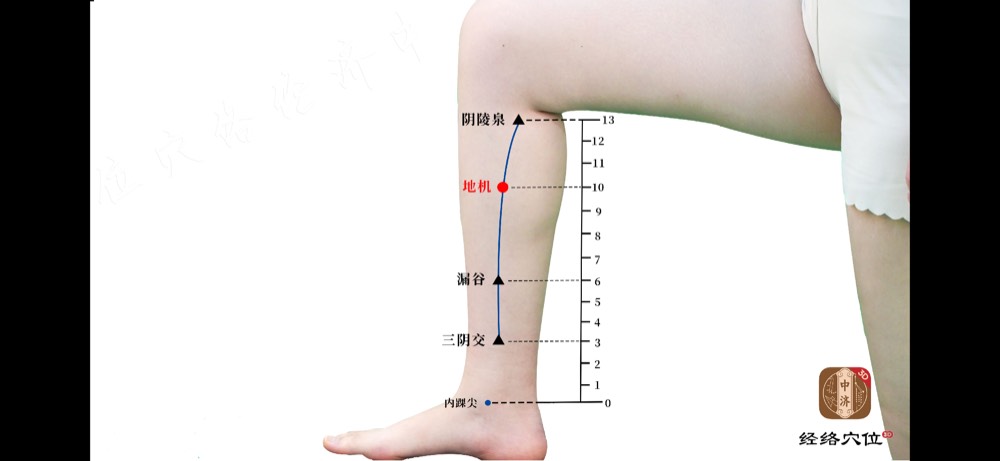
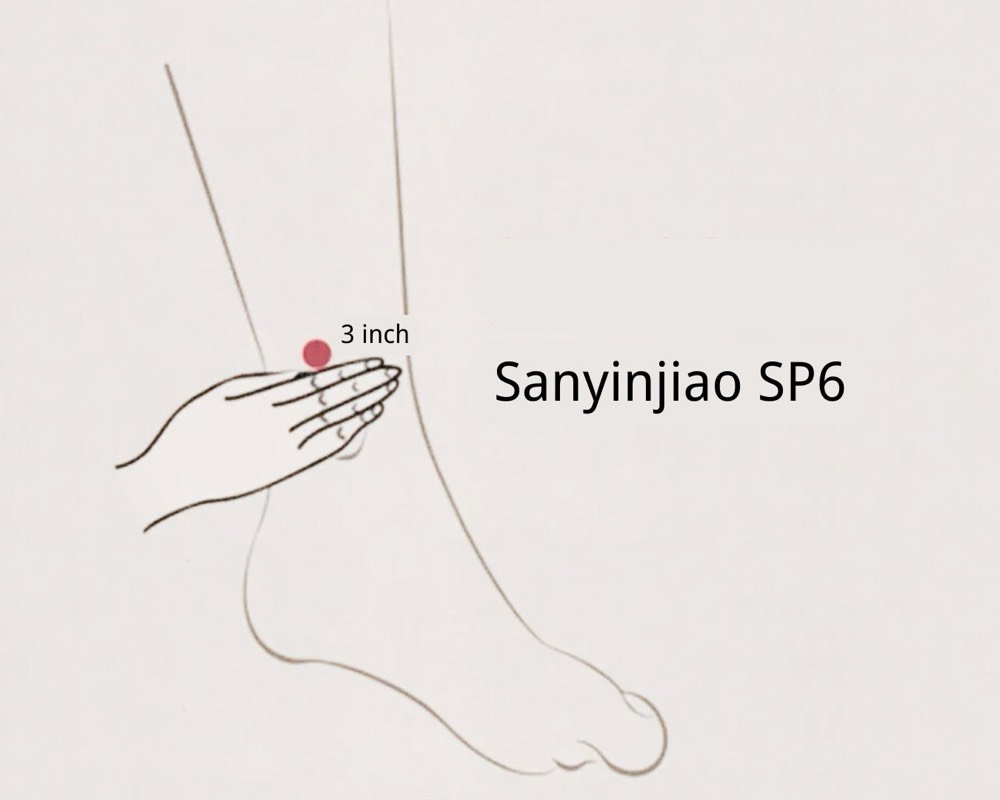
Yinlingquan SP-9 ("Yin Mound Spring") sits in the hollow below the inner knee, where your thumb comes to rest as it slides up the inner edge of the shinbone. Sanyinjiao SP-6 ("Three Yin Intersection") sits four finger-widths above the tip of the inner ankle bone, at the back edge of the shinbone.
The route between them is the classical working line for this pattern. And a firm rule attaches to the lower end of it: Sanyinjiao SP-6 must not be used during pregnancy.
What’s Real, What’s Myth
Myth: heavy legs mean you need to drink more water. In this framework the problem is not too little fluid but fluid the body is not moving well, and adding litres to a system already struggling tends to add to the heaviness. Normal amounts of warm drinks suit this pattern better than large volumes of cold water.
Myth: compression socks are a cop-out. They are not, and for people who stand all day they are genuinely useful. What they do not do is change the pattern underneath, so they belong alongside the movement and food changes rather than instead of them.
Myth: it is only about standing all day. Sitting still for eight hours produces the same result — the calf muscles are what move fluid back up the leg, and neither prolonged standing nor prolonged sitting uses them. The variable is movement, not posture.
Myth: this route is a gentle massage anyone can do. Sanyinjiao SP-6 is contraindicated in pregnancy, and that includes working the route through it. If you are pregnant, might be, or are trying to conceive, work only the upper part of the calf near the knee and speak with your own practitioner.
Real: swelling in both legs that comes and goes with the day is one thing; swelling in one leg, or swelling that does not settle overnight, is another. The second needs a doctor rather than a routine, and I would rather you checked.
Five Things You Can Do This Week
1. Work the route upward, three minutes a side. Sitting with your ankle on the opposite knee, use your thumb to stroke firmly up the inside of the shinbone from just above the ankle to just below the knee. Always upward, thirty to forty slow strokes. If you are pregnant or might be, stay in the upper half near the knee and do not work the lower section.
2. Hold Yinlingquan SP-9 ("Yin Mound Spring") for a minute each side. Slide your thumb up the inner edge of the shinbone until it stops in the hollow below the knee. This one is often distinctly tender in this pattern, and the tenderness eases over a few weeks.
3. Add Sanyinjiao SP-6 ("Three Yin Intersection") for a minute each side, four finger-widths above the inner ankle bone. Not in pregnancy — skip it entirely if there is any chance you are pregnant, and mention it to your practitioner if you are trying to conceive.
4. Use the calf pump every forty minutes. Twenty slow heel raises at your desk, or two minutes of walking. The calf muscles are what move fluid back up the leg, and forty minutes of stillness is roughly where most people start to lose ground.
5. Change the food that feeds the pattern. Less salt, less fried and rich food, fewer cold drinks. Dry-fried coix seed (炒薏米) with a thumbnail of chenpi (陈皮, aged tangerine peel) in congee is the classical kitchen pairing for heaviness — dry-fried, not raw, if you also feel the cold.
When to See a Doctor
This is the section that matters most here, because leg swelling has causes that are not pattern questions. See a doctor the same day for swelling in one leg only, especially with pain, warmth, redness or tenderness in the calf. Do not massage that leg — it needs assessment first.
Seek urgent care for leg swelling with breathlessness or chest pain. Book a GP appointment promptly for swelling in both legs that does not settle overnight, for swelling that has come on over days rather than gradually, for breathlessness when lying flat, or for needing extra pillows to sleep.
See your GP if swelling started after a new medication, if you have known heart, kidney or liver conditions, if there is swelling with unintended weight change, or if the skin over the swollen area is shiny, weeping or breaking down. Ask about basic blood work — kidney and liver function, thyroid, and iron.
And avoid firm leg work entirely if you have varicose veins along the route, a bleeding disorder, or take blood-thinning medication, and check with your doctor if you have had a blood clot in the past.
Which Constitution This Usually Points To
Heaviness in the legs by the evening, worse in humid weather and after rich food, with a swollen-edged tongue and a thick coating, points toward a phlegm-damp constitution (痰湿质). For this pattern the classical order is to cut the source first — sweets, fried food, cold drinks — and then work on moving what has gathered.
If the heaviness comes with a bitter taste, urgent bowels, strong body odour and a yellow greasy coating, that is a damp-heat picture (湿热质), and the food direction changes: raw coix seed rather than dry-fried, and cooling rather than warming.
If the legs are heavy but the dominant experience is exhaustion, a soft voice and breathlessness on stairs, a qi-deficient constitution (气虚质) is underneath, and building matters as much as moving.
The quick assessment on this site walks you through 29 gentle questions in about three minutes and gives you a daily plan matched to your type, including which form of each food suits you.
Keep Reading
How to Clear Dampness
The TCM view on heaviness, bloating, and that waterlogged feeling.
Read →What Does My Tongue Say?
Reading coating, colour, teeth marks and shape the TCM way.
Read →Morning Fog and Heaviness
Why you wake up unrefreshed after eight hours — and the pattern Chinese medicine calls dampness.
Read →Tap the Side of Your Body
A five-minute morning routine along the outer thigh for the days you wake up heavy and slow.
Read →Aged Tangerine Peel
The most used ingredient in Chinese home cooking, and the least known outside it.
Read →The Spring Reset Myth
Why a juice week leaves so many people colder and flatter — and what the classics said instead.
Read →Find Your Constitution
29 gentle questions, about three minutes, and you have your TCM body type — so this guidance actually fits you.
Take the quick quiz →Related
Learn about the Phlegm-Dampness constitution →Frequently Asked Questions
Which direction should I stroke?
Upward, from just above the ankle toward the knee, every time. Return your hand through the air rather than stroking back down. Firm but comfortable pressure, thirty to forty slow strokes per side, and best done in the evening when the heaviness is at its worst.
Can I do this if I am pregnant?
Not the full route. Sanyinjiao SP-6 is contraindicated in pregnancy, so work only the upper half of the calf near the knee, keep it gentle, and speak with your own registered practitioner. Swollen ankles in pregnancy should also be mentioned to your midwife or doctor, particularly if they come on suddenly.
Do compression socks make this unnecessary?
They help considerably if you stand all day, and they are worth using. They manage the symptom rather than the pattern, so they work best alongside the calf pump, the food changes and the route rather than as a replacement for them.
How long before my ankles stop swelling?
Most people notice the evening heaviness is less within two weeks, mainly from moving every forty minutes. Changes in the tongue coating and the underlying pattern take six to eight weeks. If the swelling is not settling overnight at all, see your GP rather than persisting.
Last updated: 2026-07-13
This page offers general TCM educational perspectives, not medical advice or a diagnosis. For any health concern, please consult a licensed healthcare professional.