Beans Leave You Bloated — The Two Kitchen Additions That Change How They Sit
Every food culture that lived on legumes worked this out. Ours mostly stopped doing it.
Reviewed by Jimmy Yu, Certified Acupuncturist · Updated 2026-07-13
Quick answer
In Chinese medicine beans and lentils are nourishing but heavy and slow to move, which is why they bloat people with a weak digestion. The traditional answer is not to avoid them but to cook them with fresh ginger and chenpi (陈皮, aged tangerine peel), and to soak them properly first.
The Plant-Based Plan That Bloated You
The decision is usually a good one and the first fortnight is usually uncomfortable. More lentils, more chickpeas, more black beans, and a belly that is visibly distended by the evening.
People are told this settles as the gut adapts, and for many it does. For a substantial group it does not, and after two months they quietly go back to what they were eating before, having concluded that beans and they do not get along.
What they describe is specific: fullness that sits low and hard, wind, a heaviness that is worse in the evening, and sometimes loose stools with undigested food visible in them.
Every food culture that lived on legumes solved this centuries ago, and none of them solved it by giving up. They solved it in the pot.
How Chinese Medicine Reads It
The Lingshu chapter "Wu Wei" (《灵枢·五味》) lays out the idea that flavours have destinations — sweet flavours travel first to the Spleen, which in this system means the whole digestive capacity rather than the organ of that name.
Beans and lentils sit squarely in that category. They are described as nourishing and substantial, which is exactly why they are valuable, and also why they are demanding. Substance has to be transformed before it can be used.
The classical image is the pot over a steady flame. A large volume of dense, slow food arriving into a weak flame does not get processed cleanly, and what does not move becomes distension and wind. That is not a failure of the food; it is a mismatch of load and capacity.
The tradition’s answer is aromatics. Fresh ginger warms and disperses, giving the flame something to work with. Chenpi (陈皮, aged tangerine peel) moves qi in the middle and keeps heavy food from sitting — which is why it appears in almost every rich dish in Chinese home cooking.
The parallel across cultures is striking. Indian cooking adds asafoetida and cumin to dal, Mexican cooking adds epazote to black beans, European cooking adds bay and savory. Every culture that ate legumes daily arrived at aromatics, independently.
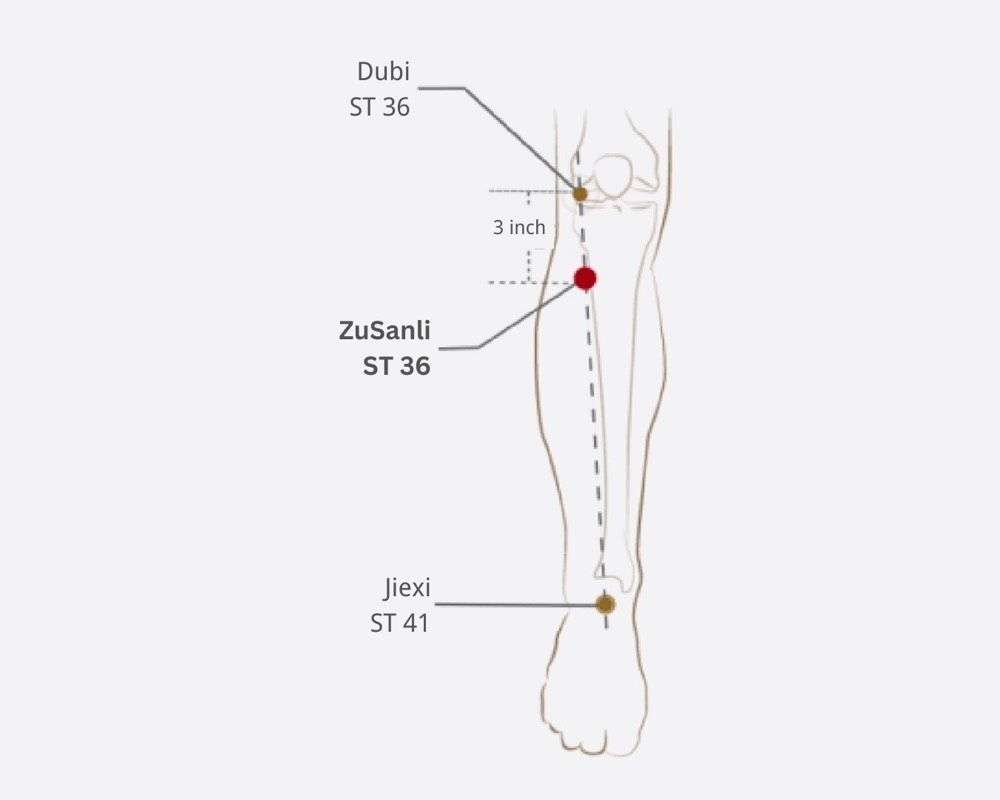
The supporting points are the usual two: Zusanli ST-36 ("Leg Three Li"), a hand-width below the kneecap and a thumb-width outside the shinbone, and Zhongwan CV-12 ("Middle Cavity"), midway between the navel and the base of the breastbone.
What’s Real, What’s Myth
Myth: bloating from beans means your gut is adapting and you should push through. Sometimes it is, and for many people it settles within a few weeks. If you are still visibly distended after two months, that is not adaptation in progress — something about the preparation or the quantity needs to change.
Myth: canned beans are just as good. They are convenient and perfectly reasonable food, but they have not been soaked with the water discarded, which is where a good deal of the problem lives. Rinsing them thoroughly helps. Cooking dried beans yourself, with a long soak, helps considerably more.
Myth: you need to eat them daily to get enough protein on a plant-based diet. Variety across the week does the same job with far less load on the digestion. Rotating lentils, tofu, tempeh, eggs if you eat them, nuts and grains suits this pattern much better than a large bowl of chickpeas every day.
Myth: raw sprouted beans are the most digestible form. Sprouting changes the chemistry usefully, but raw and cold is the hardest presentation for a weak digestion in this framework. Sprouted and then lightly cooked gets you both advantages.
Real: the soak and the discarded water matter more than most people expect. Eight to twelve hours, water thrown away, fresh water for cooking. This is unglamorous, requires planning, and is the step most often skipped.
Six Things to Do Differently
1. Soak dried beans for eight to twelve hours and throw the water away. Cook in fresh water. Lentils need less — two hours is plenty for red lentils, and split ones need none. This is the foundation the rest sits on.
2. Add three or four slices of fresh ginger to the pot. Not enough to taste strongly in the finished dish, just enough to change how it sits. This is the single most useful addition and it works in every bean dish I have tried it in.
3. Add a thumbnail piece of chenpi (陈皮, aged tangerine peel). It disappears into the flavour of a stew or a dal and does the work of keeping heavy food moving. Buy it once from a Chinese grocer and it lasts years.
4. Cook them longer than the packet says. Properly soft rather than firm makes a genuine difference to how they sit, and it is the way beans are cooked in every culture that relies on them. Firm beans in a salad are the modern version and the harder one.
5. Halve the portion for a fortnight. A large bowl of beans is a substantial load however well prepared. Half a cup cooked, alongside a grain and cooked vegetables, suits a weak digestion far better than a bowl of chickpea stew — and you can build up from there.
6. Walk for ten minutes afterwards and press Zusanli ST-36 ("Leg Three Li") for a minute each side. A short walk after the evening meal does more for this pattern than most things people buy, and it costs ten minutes.
When to See a Doctor
Bloating that does not fluctuate deserves a proper look. See your GP for bloating that is persistent rather than coming and going, for a change in bowel habit lasting more than three weeks, or for bloating with unintended weight loss. In women, persistent bloating with abdominal or pelvic discomfort should always be assessed.
Seek advice promptly for blood in your stool or black stools, for persistent vomiting, or for abdominal pain that is severe, new or waking you at night. Ask about coeliac disease if symptoms are consistent regardless of preparation, since it is common and frequently missed.
If you eat mainly plant-based, ask your GP to check iron, ferritin, B12 and vitamin D at least once. B12 in particular needs attention on a fully plant-based diet, and no amount of food preparation substitutes for measuring it.
And if bloating comes with severe pain, cramping and urgent bowels in a recognisable pattern, or if you have been avoiding whole food groups for months, that is worth discussing with your GP or a dietitian rather than narrowing your diet further on your own.
Which Constitution This Usually Points To
Bloating and wind after substantial meals, tiredness after eating, loose stools and a soft voice point toward a qi-deficient constitution (气虚质) with a weak digestive flame. For that pattern the order is fixed: reduce the load first, support the digestion second, and increase again once it holds.
If the picture is heaviness with a thick greasy tongue coating rather than tiredness, a phlegm-damp constitution (痰湿质) is the more likely reading, and the ginger and peel matter even more.
If bloating tracks with your stress levels rather than with what you ate, the lead is qi stagnation (气郁质), and no amount of soaking will change it — walking will.
The quick assessment on this site walks you through 29 gentle questions in about three minutes and gives you a daily plan matched to your type, including how much of this kind of food actually suits you right now.
Keep Reading
Always Tired After Sleeping?
When a full night's rest still leaves you exhausted — the TCM view.
Read →Why Do I Sweat So Easily?
Daytime sweat, night sweats, sweaty palms — the TCM reading.
Read →When You Fit Two Types
Cold hands but mouth ulcers? Tired but wired? How to read a mixed constitution and what to work on first.
Read →When the Famous Point Backfires
Light-headed and flat after pressing the point below your knee? The technique, not the point, is usually the problem.
Read →The Classical Sweat Pair
Why one pair of points was used for both drenching sweat and no sweat at all — and how the direction changes.
Read →Late Autumn Burnout in Men
Why the same flat, heavy tiredness arrives every year around the same time — and what the classics said to do about it.
Read →Find Your Constitution
29 gentle questions, about three minutes, and you have your TCM body type — so this guidance actually fits you.
Take the quick quiz →Related
Learn about the Qi Deficiency constitution →Frequently Asked Questions
Does the ginger make everything taste of ginger?
Not at three or four slices in a pot. It disappears into a dal, a stew or a chilli and you notice its absence more than its presence. If you dislike ginger, fennel seed or cumin play a similar aromatic role in this framework, though ginger is the warmest of the three.
Are lentils easier than beans?
Generally yes. Split red lentils are the lightest of the common legumes and need no soaking, which makes them the sensible starting point if beans have been a problem. Chickpeas and kidney beans are the heaviest and the ones most worth soaking properly.
How long before my digestion adjusts?
With proper soaking, aromatics and smaller portions, most people notice a difference within a week or two. Genuine adaptation over a few months is real as well. If you are still visibly distended after two months of doing it properly, see your GP rather than persevering.
Is a bean salad a bad idea?
For this pattern it is the hardest version — cold, firm and often in volume. If you want one, use well-cooked soft beans rather than firm ones, keep the portion modest, and have it at lunch rather than in the evening when the digestion is winding down.
Last updated: 2026-07-13
This page offers general TCM educational perspectives, not medical advice or a diagnosis. For any health concern, please consult a licensed healthcare professional.