Back From the Trip and Still Not Right — Re-anchoring the Day After Long Travel
The classics describe a circuit that completes fifty times a day. Travel breaks it, and there is an order to restarting it.
Reviewed by Jimmy Yu, Certified Acupuncturist · Updated 2026-07-13
Quick answer
The Lingshu describes qi circulating through the body on a fixed daily circuit that completes fifty times between one nightfall and the next. Long travel disrupts that rhythm, and the classical approach is to re-anchor it in order — light first, meals second, sleep last — rather than all at once.
A Week Home and Still Off
The first two days after a long flight are expected. It is day six that puzzles people — home, back at work, and still waking at half past three, hungry at midnight, and flat at eleven in the morning.
The pattern is usually more digestive than people expect. Appetite arriving at the wrong hours. Bowels that have not settled. A middle that feels heavy after meals that were fine a fortnight ago.
There is a mental version too: a slight sense of being one step behind, of not quite arriving, that lingers after the sleepiness has gone.
And it lasts longer with age. Most people notice in their forties that a trip that used to cost them two days now costs them a week, which is worth planning around rather than being surprised by.
How Chinese Medicine Reads It
The Lingshu chapter "Ying Wei Sheng Hui" (《灵枢·营卫生会》) describes the daily circuit
营在脉中,卫在脉外,营周不休,五十而复大会
the nourishing qi travels within the vessels and the defensive qi outside them, circulating without pause, meeting again after fifty circuits.
《灵枢·营卫生会》
Fifty circuits between one nightfall and the next. Whatever you make of the number, the underlying claim is that the body runs on a fixed daily rhythm, and that things happen in a set order rather than whenever convenient.
The same chapter describes the defensive qi as being at the surface through the day and moving inward at night — which is the transition that fails when you land and cannot sleep, or sleep and cannot wake.
Travel disrupts this in more ways than the time zone alone. Long stretches of stillness, unfamiliar and often cold or rich food, dehydrated cabin air, disrupted meals, and days of low daylight exposure. In classical terms you have interrupted the circuit and added damp and cold to the middle at the same time.
This is why the digestive symptoms so often outlast the sleepiness. The rhythm resets faster than the middle does, and people judge their recovery by their sleep while the actual lag is in their digestion.
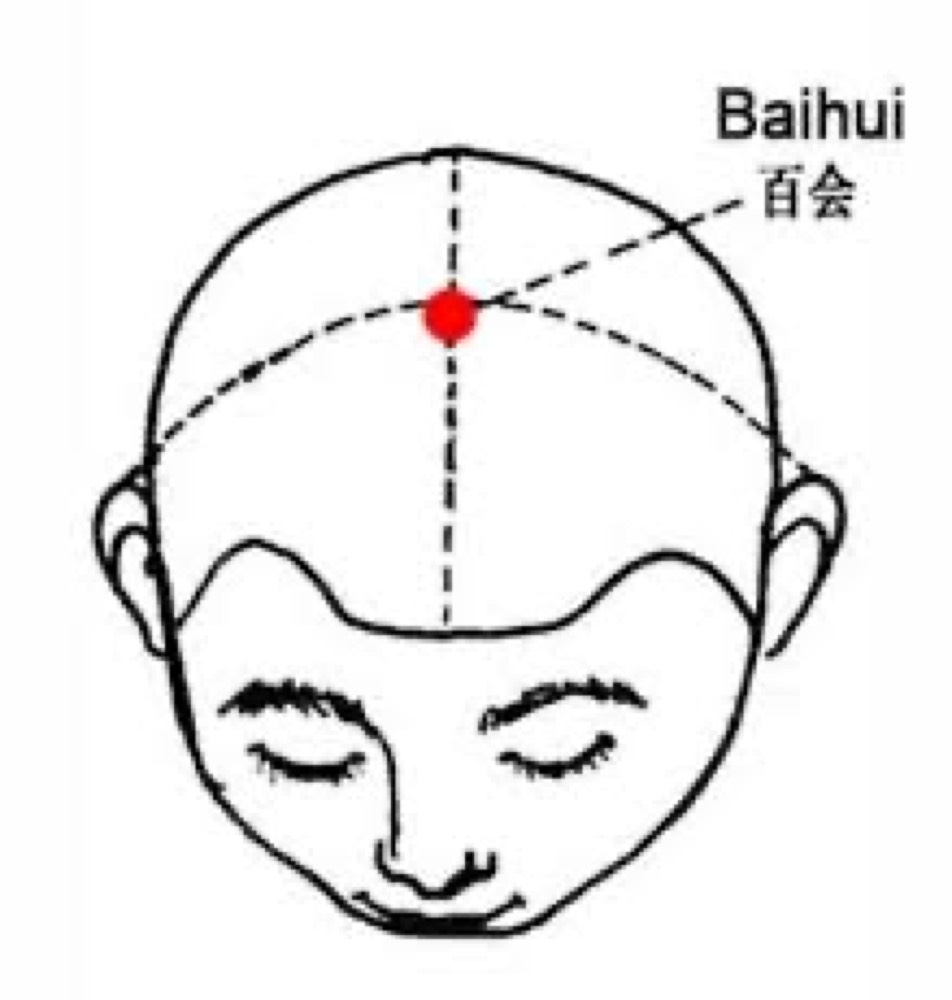
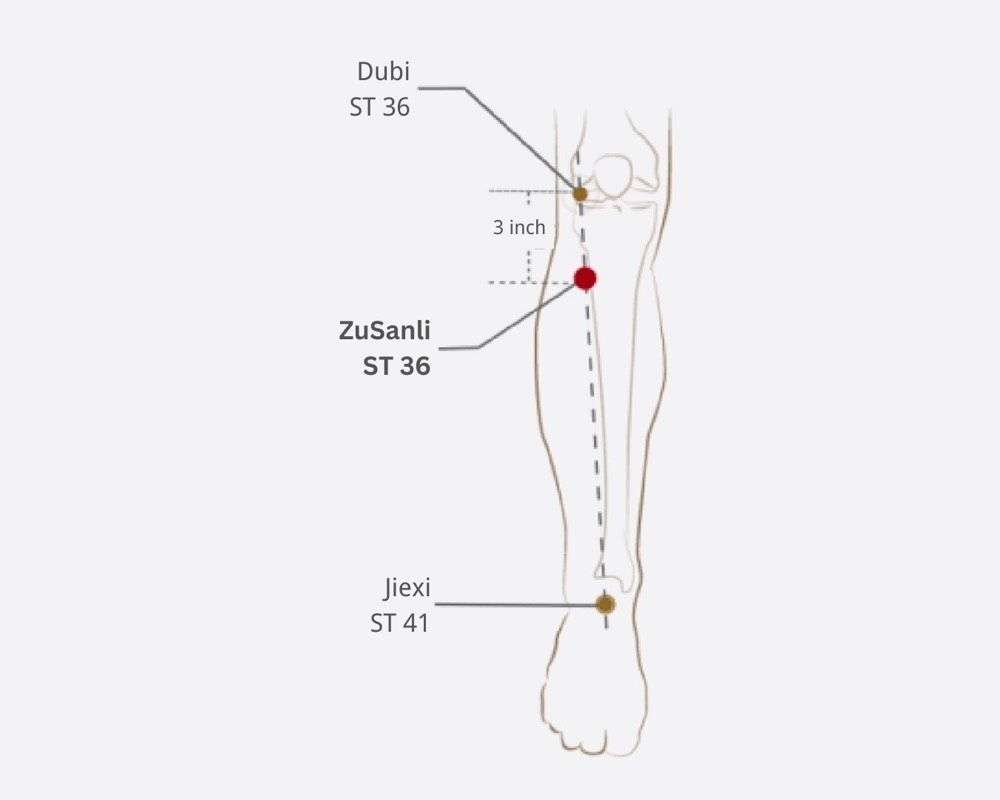
The points are supportive rather than corrective. Zusanli ST-36 ("Leg Three Li") sits a hand-width below the kneecap. Baihui GV-20 ("Hundred Convergences") sits at the crown, where a line between the ear tips crosses the midline. Yongquan KI-1 ("Bubbling Spring") sits in the hollow on the sole, for the evening end of the day.
What’s Real, What’s Myth
Myth: you should power through and stay awake until local bedtime whatever happens. That works for short shifts and backfires badly for long ones, particularly after forty. A short nap of twenty to thirty minutes before three in the afternoon costs you nothing and prevents the collapse at six that ruins the following night.
Myth: it is only about sleep. In this framework the meal times matter as much as the sleep times, and they are easier to control. Eating at local hours from the first morning does a surprising amount of the work.
Myth: a big meal on arrival helps you settle. A heavy late meal after long travel is the most common reason people describe a heavy, uncomfortable first week. Warm, light and early suits far better — congee, soup, something cooked.
Myth: alcohol on the flight helps you sleep. It gets people to sleep and then wakes them a few hours later as it clears, which is precisely the mechanism you are trying to avoid on a night flight. It also worsens the dehydration.
Real: daylight in the first hour of the local morning is the strongest lever available, and it is free. Ten to twenty minutes outside, ideally walking. It outperforms every supplement in this area and most people skip it because it is unglamorous.
The Order to Put the Day Back
1. Light first. Get outside within the first hour of waking, local time, for ten to twenty minutes, and walk while you are there. If you are travelling west to east, morning light is what you need; going east to west, late-afternoon light helps more. This is the anchor everything else hangs off.
2. Meals second, at local times, from the first day. Warm and cooked rather than cold and raw, and modest rather than large. Eating at local hours is the second strongest signal after light, and it is entirely within your control.
3. Sleep last, and do not force it. Go to bed at a reasonable local hour, and if you are awake at three, stay warm and in the dark and breathe out slowly rather than reaching for a screen. Sleep is the slowest of the three to come back and it follows the other two.
4. Nap once, briefly, before three in the afternoon. Twenty to thirty minutes, an alarm, not on the sofa in the evening. This is the difference between a manageable day and a wrecked night.
5. Support the middle for the first week. Congee or soup for at least one meal a day, a thumbnail of chenpi (陈皮, aged tangerine peel) in anything rich, and press Zusanli ST-36 ("Leg Three Li") for a minute each side after your evening meal. Then a ten-minute walk.
6. Bookend the day with two points. Tap Baihui GV-20 ("Hundred Convergences") lightly for a minute in the morning when the fog is thickest, and rub Yongquan KI-1 ("Bubbling Spring") on each sole for a minute before bed to settle things downward.
When to See a Doctor
Long flights carry a specific risk worth knowing. See a doctor the same day for pain, swelling, warmth or redness in one calf after a long flight, and seek emergency care for breathlessness, chest pain or coughing blood in the days afterward. Do not massage a swollen calf.
Book a GP appointment for fever, persistent diarrhoea, or vomiting after travel, particularly from areas where mosquito-borne or waterborne illness is a consideration — and mention where you have been, since that changes what they look for.
See your doctor if the disruption has not settled after two to three weeks, if you are exhausted through the day, or if you are relying on alcohol or sleeping tablets to manage it. If you travel across time zones frequently for work, that is worth a proper conversation rather than absorbing indefinitely.
And if low mood, anxiety or a sense of not being yourself persists beyond the first fortnight home, please raise it with your GP. Repeated circadian disruption affects mood in ways people often attribute to the travel and then leave unaddressed.
Which Constitution This Usually Points To
Recovering from travel within a few days, with sleep and appetite finding their way back on their own, suggests a balanced constitution (平和质) — and for that picture the sensible approach is the ordinary one: light, local meal times, and patience.
If travel reliably leaves you flat for a fortnight, breathless on stairs and catching whatever is going around, a qi-deficient constitution (气虚质) is underneath, and the answer is to build in a recovery day rather than to schedule a meeting the morning after landing.
If the lasting complaint is heaviness, a thick tongue coating and sluggish digestion, a phlegm-damp picture (痰湿质) is leading, and the food side of this list matters more than the light.
The quick assessment on this site walks you through 29 gentle questions in about three minutes and gives you a daily plan matched to your type, adjusted for the season and location you are actually in.
Keep Reading
Why the Same Diet Fails You
Why an eating plan that transformed your friend can leave you bloated, cold and flat — and what to look at instead.
Read →Seven Everyday Foods
Ordinary supermarket items the tradition has used for centuries — and who each one actually suits.
Read →Seasons Across Hemispheres
How to translate seasonal Chinese medicine advice if you live south of the equator — or moved.
Read →Why Am I Always Cold?
The TCM take on cold hands, cold feet, and never feeling warm.
Read →How to Clear Dampness
The TCM view on heaviness, bloating, and that waterlogged feeling.
Read →Always Tired After Sleeping?
When a full night's rest still leaves you exhausted — the TCM view.
Read →Find Your Constitution
29 gentle questions, about three minutes, and you have your TCM body type — so this guidance actually fits you.
Take the quick quiz →Related
Learn about the Balanced Constitution constitution →Frequently Asked Questions
How long should recovery take?
A rough guide is about a day per time zone crossed, and longer travelling west to east. After forty it tends to take longer than it used to. If you are still clearly disrupted after two to three weeks, that is worth a GP appointment rather than waiting it out.
Is napping allowed?
Yes, once, briefly, and before three in the afternoon. Twenty to thirty minutes with an alarm. What wrecks the following night is the unplanned ninety-minute collapse at six in the evening, which is exactly what happens if you refuse the short nap earlier.
Why is my digestion the last thing to come back?
In this framework the rhythm resets faster than the middle does, especially after a week of unfamiliar, rich or cold food and long stretches of sitting. Warm, light, cooked meals at local times for the first week is the specific answer, and most people underestimate how much it does.
Does the direction of travel matter?
Considerably. Travelling east is generally harder because you are asking the day to shorten, and morning light is what helps there. Travelling west is easier and late-afternoon light helps more. Getting the light timing the wrong way round can hold the adjustment back by days.
Last updated: 2026-07-13
This page offers general TCM educational perspectives, not medical advice or a diagnosis. For any health concern, please consult a licensed healthcare professional.